
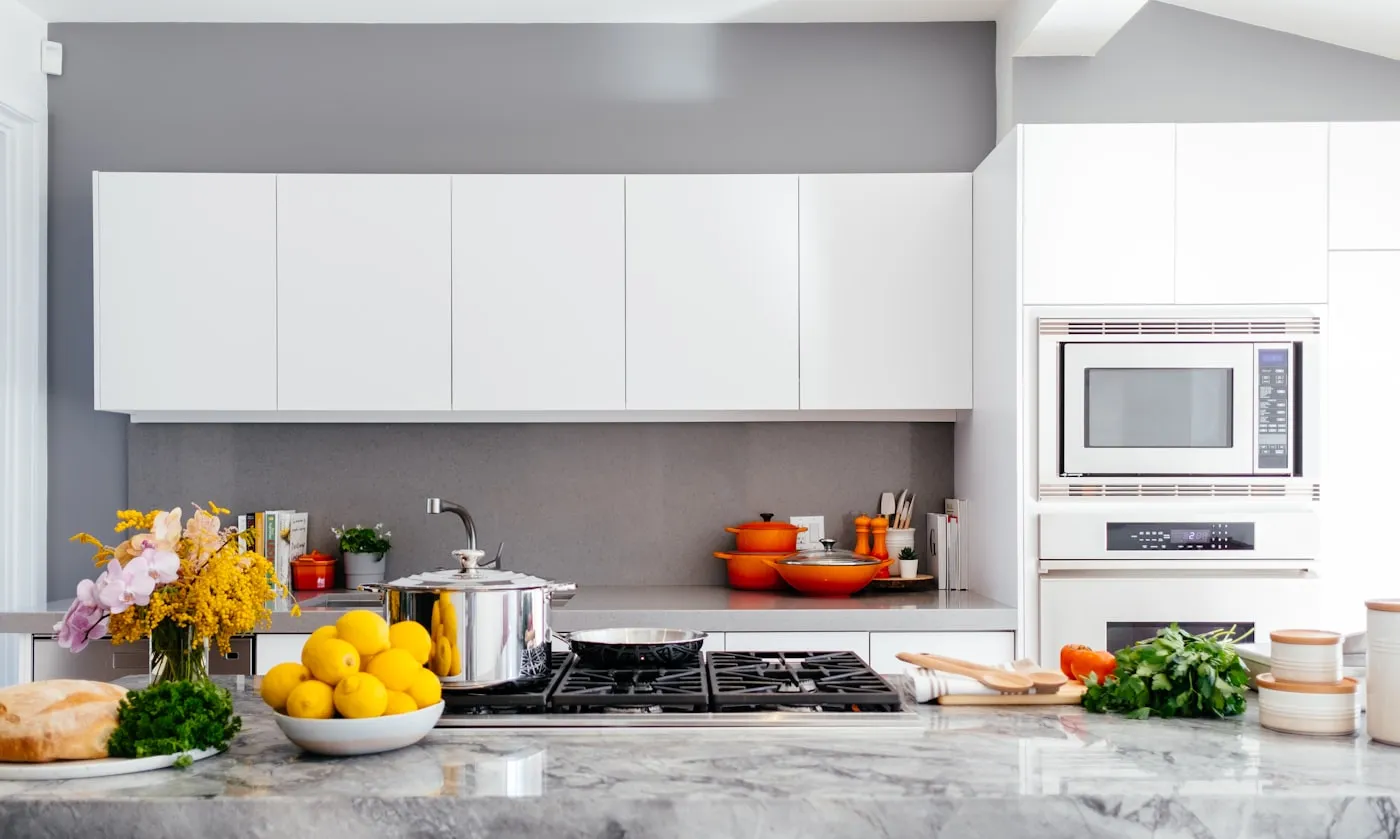
Some design trends announce themselves. A trend for terrazzo, or open shelving, or two-tone cabinets. You can spot them from across a magazine spread, and you can usually date a kitchen by them.
Japandi is not that kind of trend. It’s quieter. A Japandi kitchen doesn’t reveal itself in any single feature; it’s the absence of features that gives it away. The eye lands on the room and doesn’t immediately know why it feels calm. That’s the point.
This is the anchor piece for everything we publish under Japandi & Zen Design. What Japandi actually is (and isn’t), the principles that make it work, and how to bring it into your kitchen whether you’re renovating or just restyling a rental.
Where Japandi comes from
Japandi is a portmanteau, and an honest one. It describes the meeting of two design traditions that, despite coming from opposite sides of the planet, have always agreed on the essentials.
Japanese wabi-sabi is the aesthetic of imperfection, impermanence, and incompleteness. It finds beauty in things that are handmade, weathered, asymmetric, and honest about their materials. The cracked ceramic bowl repaired with gold. The weathered wood. The uneven glaze.
Scandinavian hygge is the design culture of warmth, comfort, and light. Long dark winters produced an aesthetic that maximizes coziness: pale woods, soft textiles, candles, the gentle embrace of a room that wants you to stay.
Where they overlap is the interesting part. Both traditions prize natural materials, restraint, craft, and a calm relationship to empty space. Both treat the home as something that should support well-being, not impress visitors. Japandi is the name we’ve given to that overlap.
What Japandi is not: a specific color, a specific cabinet style, or a shopping list of objects. It’s a set of instincts about how a room should feel.
The six principles
You can read a thousand Japandi kitchens through six principles. None of them is hard to apply; together, they’re what produce the calm.
1. Material honesty
A Japandi kitchen uses materials that are allowed to be themselves. Wood looks like wood. Stone looks like stone. Plaster looks like plaster. The opposite, vinyl printed to look like oak or tile printed to look like marble, is what gives a kitchen that slightly uncanny “showroom” feeling, even when it’s expensive.
This doesn’t mean you need rare or costly materials. It means choosing fewer of them and letting each one tell the truth.
2. A muted, earthy palette
The classic Japandi palette is built from nature. Off-whites, warm beiges, soft grays, muted greens, the browns of bare wood, the occasional black accent for contrast. Saturation stays low. The eye gets to rest.
Where color enters, it’s usually from the materials themselves. The green of an herb plant, the ochre of a clay bowl, the warm rust of an unglazed terracotta pot. Not from painted surfaces.
3. Negative space as a material
This is the principle most people miss. In a Japandi room, empty space is treated as a design element, not as a problem to be filled. A long bare stretch of counter, an empty shelf, a wall with a single object on it. These are deliberate choices.
Practically, this means resisting the urge to add “finishing touches” to every surface. The room is finished when removing anything else would make it worse.
4. Low visual contrast
Japandi kitchens tend to use tone-on-tone relationships rather than sharp contrasts. Cabinets, counters, floors, and walls sit close to each other on the color wheel. The effect is a room that reads as a single calm field, with texture (the grain of the wood, the matte of the stone) doing the work that color usually does.
When contrast appears, it’s used sparingly and intentionally. A black faucet against pale stone. A dark wooden stool against a pale floor.
5. Organic, imperfect forms
Rigid symmetry is rare in a Japandi kitchen. Instead: soft edges, natural variation, and a tolerance for imperfection. A handmade ceramic basin with a slightly uneven rim. A counter with a live edge. Cabinet pulls that don’t all match exactly. The room feels made, not manufactured.
This is where wabi-sabi specifically shows up, in the celebration of the human hand and the passage of time.
6. Warm, layered light
A Japandi kitchen is rarely lit from a single overhead source. Instead, light is layered. Ambient soft light for the overall room, task light where the work happens, candle or accent light for warmth in the evening. The light tends toward the warm end of the spectrum, reinforcing the cozy Scandinavian half of the equation.
A dimmer on every switch is, surprisingly, one of the most effective Japandi upgrades you can make.
How to get the look without renovating
The good news: you don’t need to gut your kitchen to live in a Japandi one. Most of the look is in styling and subtraction, not construction. A few high-impact, low-cost moves:
- Clear the counters. The single most effective thing you can do. A Japandi kitchen is defined by its empty surfaces. Edit ruthlessly.
- Edit your palette. If your kitchen is full of competing colors, red kettle, blue canisters, green towels, quietly swap toward a unified set of neutrals over time. You don’t have to do it all at once.
- Add wood. A wooden cutting board leaning against the backsplash, a wooden bowl on the counter, a small wooden stool. The warmth of bare wood is the fastest route to the aesthetic.
- Hide the plastics. Transfer pantry staples to glass jars. Replace plastic utensils with wood or stainless. The transparency and clutter of packaging is the opposite of the Japandi mood.
- Bring in one living thing. A single herb plant, a branch in a vase, a bowl of citrus. The room needs a pulse.
- Soften the light. Swap cool bulbs for warm (2700K is the sweet spot), add a small lamp somewhere unexpected, light a candle at dinner.
None of these requires a contractor. Together, they shift a kitchen more than you’d expect.
If you are renovating
For those actually building, here’s where to invest the Japandi budget:
- Cabinetry in natural wood or warm matte paint. Flat-panel or shaker, in oak or ash, or painted in off-whites, warm grays, or muted sage and clay tones. Avoid high-gloss finishes.
- Counters in honed or leathered stone. Matte finishes read as more organic than polished. Soapstone, honed marble (embrace the patina), warm granites, or quartz with a matte finish all work.
- Integrated or apron-front sinks. A sink that disappears into the counter, or a farmhouse sink with a warm apron, keeps the visual line clean.
- Handleless or simple pull hardware. Touch-to-open cabinets, integrated finger pulls, or very simple matte black or brass pulls. Hardware is jewelry; keep it understated.
- Open shelving in wood, sparingly. A single run of open shelving, styled minimally, breaks up the cabinetry and lets you rotate a few beautiful objects.
- Under-cabinet and in-cabinet lighting on dimmers. The layered-light principle, built in.
The temptation to over-design
The hardest thing about a Japandi kitchen is the discipline to stop. It’s easy to keep adding. Another beautiful object. Another thoughtfully chosen material. Until the calm is gone and you’ve built a maximalist room in minimalist clothes.
When in doubt, remove. Live with the room for a month before adding anything new. The principles are stable; the specific objects are personal.
A Japandi kitchen isn’t a look you achieve and then stop. It’s ongoing attention to how a room feels, and small adjustments toward calm.
Read more from the Japandi & Zen Design pillar.