
Caraway Cookware Review: 6 Months of Honest Testing
We cooked on Caraway's ceramic set every day for six months. Here's the honest verdict on the non-toxic claims, induction, coating longevity, and whether $395 is worth it.
When a category gets trendy, two things happen at once. The genuinely good products get easier to find. And the marketing language gets harder to trust.
“Non-toxic” cookware is firmly in this phase. Every brand now slaps the phrase on the box, and the words themselves have started to mean almost nothing. A pan can say non-toxic and still be made of materials you wouldn’t choose if you knew the details.
This is the anchor piece for everything we publish under Non-Toxic Product Curation. The goal isn’t to scare you into throwing out every pan you own. It’s to give you a working understanding of cookware materials, what the labels mean, and how to make calm, informed decisions about what you cook with.
There’s no legal definition of non-toxic as it applies to cookware. That’s the first thing to understand. It’s a marketing word.
What people usually mean, and what we’ll mean throughout, is one or more of the following:
When a brand says non-toxic, check which of these they’re actually claiming. A pan that’s PFOA-free but uses a PTFE coating is not the same as a pan that’s PFAS-free. A ceramic pan should name its glaze standards specifically.
The trustworthy brands tell you exactly what is, and isn’t, in the pan. The vague ones hide behind the word non-toxic and hope you don’t ask.
Here’s the short version, material by material. Each of these gets a deeper review elsewhere on the site; this is the map.
Three-ply or five-ply clad stainless steel is the workhorse of the non-toxic kitchen. The cooking surface is inert, durable, and doesn’t retain flavors. It’s what most professional kitchens use for a reason. Look for pans labeled 18/10 (the ratio of chromium to nickel) with an aluminum or copper core for even heating.
Verdict: Excellent. A one-time investment that lasts decades.
Bare cast iron is elemental. Literally iron, nothing else. It requires seasoning and a little more care, but it’s nearly indeestructible and naturally develops a semi-nonstick surface over time.
Enameled cast iron (think Le Creuset, Staub) coats the iron in a vitreous glass enamel. High-quality enamel is inert; the only concern historically has been lead or cadmium in older or low-quality colored glazes. Reputable brands publish their testing.
Verdict: Excellent. Bare iron for searing; enameled for braises and stews.
Carbon steel is to a skillet what stainless is to a saucepan. A thin, responsive, practically eternal pan that seasons like cast iron but weighs less and heats faster. Popular in restaurant kitchens and increasingly in design-conscious homes (you’ve seen the de Buyer-style skillets on everyone’s shelves).
Verdict: Excellent for cooks willing to maintain a seasoning.
This is where the category gets complicated. Most “ceramic non-stick” pans (Caraway, GreenPan, Our Place, and many others) use a sol-gel coating, a silica-based film that’s PFAS-free and PTFE-free out of the box.
The good news: they’re genuinely free of the chemicals most people are trying to avoid. The catch: ceramic coatings lose their non-stick properties faster than traditional PTFE. Expect two to four years of true non-stick performance before the pan needs replacing or re-seasoning, depending on use.
Verdict: Good, with caveats. Best for cooks who want a true non-stick surface without PFAS and are willing to replace the pan periodically.
The classic black non-stick, Teflon and its cousins, uses a PTFE coating, which is a PFAS. Modern PTFE pans no longer use PFOA in manufacturing, but the coating itself remains a fluoropolymer.
If avoiding PFAS is your priority, these pans don’t qualify, regardless of what the PFOA-free label implies. They also degrade with high heat and scratching, which shortens their useful life.
Verdict: Skip, if you’re building a non-toxic kitchen.
Bare aluminum cookware is reactive. It can leach into acidic foods and is generally avoided for daily cooking. Most aluminum pans are anodized (sealed) or clad in stainless, both of which solve the issue. Cheap, uncoated aluminum is best reserved for baking sheets where contact is brief.
Verdict: Fine when anodized or clad. Avoid bare aluminum for simmered acidic dishes.
Copper is unmatched for heat responsiveness, but raw copper is toxic in quantity. All cooking copper should be lined, traditionally with tin, now usually with stainless steel. Lined copper is beautiful, performant, and expensive.
Verdict: Excellent when lined. An investment piece, not a starter pan.
You do not need to replace every pan at once. That way lies panic and a large credit card bill.
If you’re prioritizing, here’s the order we’d follow:
Leave for last: the specialty pans you use a few times a year. The exposure from a single annual use is small; the cost of replacing everything at once is not.
A quick checklist for evaluating any “non-toxic” pan:
Rather than a list of fifty pans, three. Each represents a different approach:
With those three, you can cook nearly anything, on any heat source, for a long time. Add a ceramic non-stick skillet specifically for eggs and delicate items, if you want one, but know it’ll need replacing every few years.
The quieter, slower path, buying a few excellent things and keeping them forever, turns out to also be the non-toxic path. You don’t have to choose between a kitchen that’s safe and one that’s calm.
This is the anchor. From here we go into hands-on reviews of specific pans, comparisons between brands, and the occasional investigation when a label doesn’t match what’s in the box. The standard we hold everything to is simple: safe materials, honest marketing, and built to last.
Read more from the Non-Toxic Product Curation pillar.
Non-Toxic
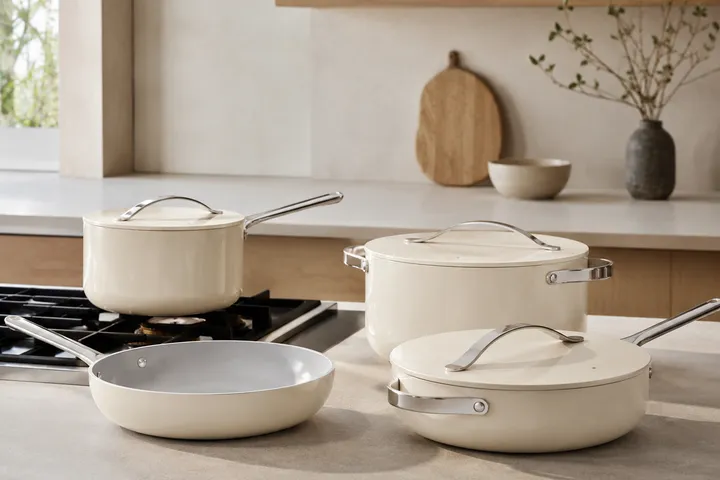
We cooked on Caraway's ceramic set every day for six months. Here's the honest verdict on the non-toxic claims, induction, coating longevity, and whether $395 is worth it.
A direct comparison of GreenPan and Caraway ceramic-coated cookware — coating technology, heat performance, durability over time, price, and which one makes sense for different kitchens.
A clear-headed look at what 'ceramic' cookware actually means, what coatings are used, which certifications matter, and how to tell whether a ceramic pan is genuinely non-toxic or just marketed that way.