
GreenPan vs Caraway: Which Non-Toxic Cookware Is Worth It?
A direct comparison of GreenPan and Caraway ceramic-coated cookware — coating technology, heat performance, durability over time, price, and which one makes sense for different kitchens.
Last updated: June 2026. Zen Kitchen earns a commission if you buy through some of our links, at no extra cost to you. We only recommend things we’d cook on ourselves.
Caraway is worth it if you want a genuinely PFAS-free ceramic set that looks beautiful and cooks well from the first egg. After six months of daily use, that’s our verdict. There’s one real catch: the coating wears down in roughly one to three years, so think of it as a lovely thing you’ll replace, not an heirloom.
That’s the short version. The longer version is more interesting, because Caraway is one of the few brands whose non-toxic claims actually hold up when you go looking, and one of the few whose biggest weakness is the thing it’s most famous for.
Yes, on the specific things people worry about. Independent testing reports no detectable PFAS, PFOA, PTFE, lead, or cadmium on the cooking surface, and a 2025 advertising ruling found Caraway has a reasonable basis to call its pans “free of PFAS” and “non-toxic.” The honest nuance is that the full coating recipe is proprietary, and “not detected” means below the lab’s reporting limit, not literally zero.
Here’s what’s underneath the marketing. Caraway’s coating is a sol-gel ceramic, sprayed on and fired at a few hundred degrees rather than the 2,000°F-plus you’d need for true ceramic. The company describes it as a silica-based matrix with a small amount of proprietary binders. That last word is where skeptics dig in, and fairly so. You can’t fully audit a formula nobody will publish.
What you can audit is the testing. Caraway works with Light Labs, an accredited independent lab, and publishes the results: more than 200 types of PFAS and 20-plus heavy metals, all reported as not detected on the ceramic surface. When Consumer Reports ran ceramic-coated pans through its own PFAS screen, it found none either. And toxicologists tend to land in the same place. One researcher at Michigan State’s ingredient-safety center told TODAY that ceramic coatings are generally free of chemicals of concern and considered non-toxic to people and the environment.
So why the asterisk? A few reasons worth knowing before you spend $400.
In August 2025, the National Advertising Division reviewed a challenge from a coalition of cookware makers. It upheld Caraway’s “free of PFAS” and “non-toxic” claims, but told the brand to stop implying that competitors’ nonstick pans are toxic, noting that the fumes from conventional nonstick only become a real concern at extreme temperatures most home cooks never hit. Then, in February 2026, the makers of All-Clad and Farberware sued Caraway for false advertising over the same messaging. Caraway’s CEO called it a meritless tactic to claw back market share, and the case is still open.
None of that changes what’s in your pan. It does tell you something about how aggressively the category markets fear, and Caraway has been part of that. The product is clean. Some of the advertising was not.
The flagship Caraway set is four cooking vessels, four lids, and a storage system, priced around $395. That works out to roughly $111 per pan, which is clad-cookware money for a pan with a finite coating, so you’re paying for design and tested safety as much as the cooking surface itself.
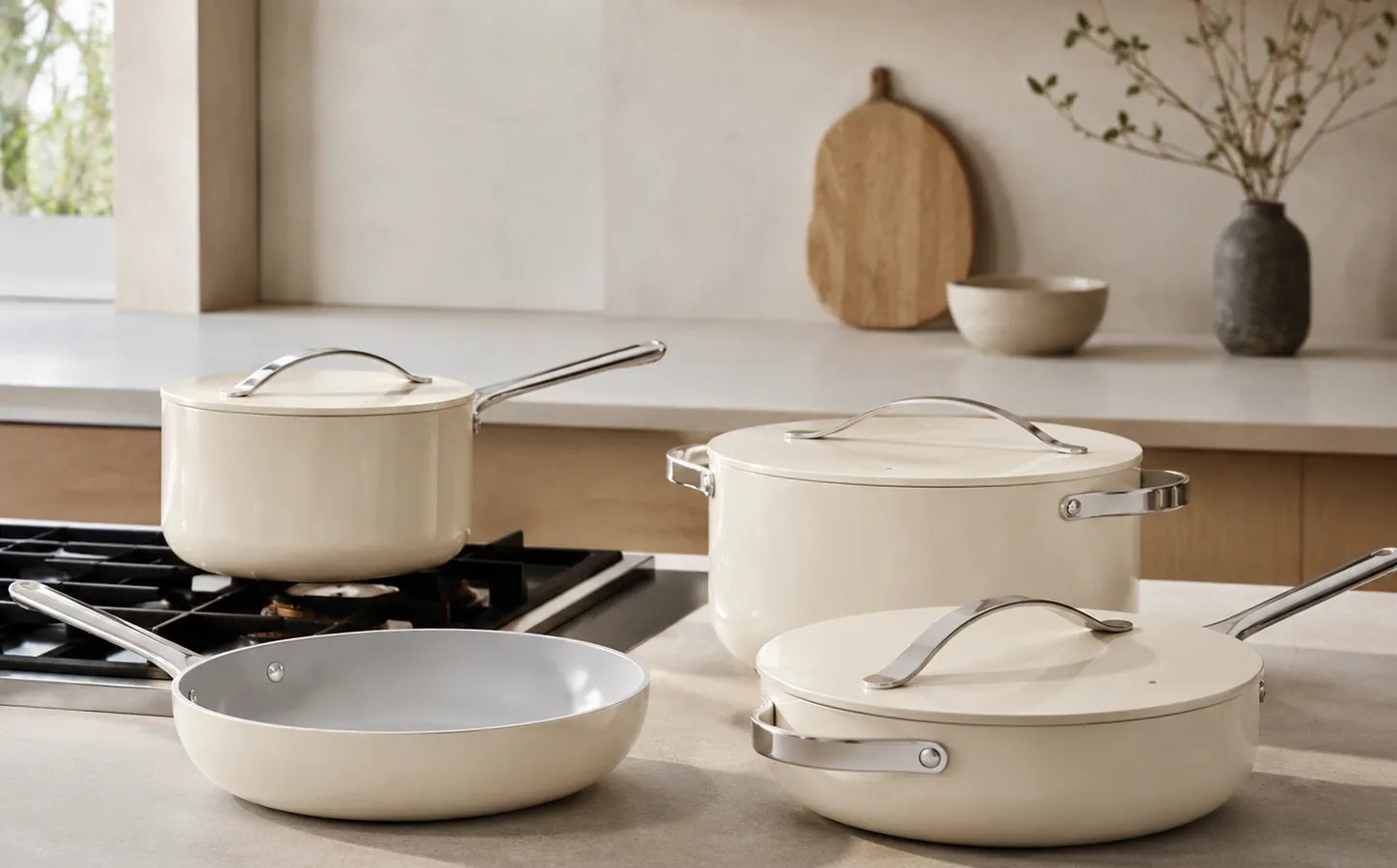
The set includes a 10.5-inch fry pan, a 3-quart saucepan, a 4.5-quart sauté pan, and a 6.5-quart Dutch oven, each with a lid. The extras are the part people actually rave about: four magnetic racks that hold the pans vertically inside a cabinet, plus a canvas holder for the lids. If your kitchen is small, this is the real selling point. The pans take up a fraction of the space a normal stack would.
A few specs worth pinning down, because they come up constantly:
One number deserves a flag. The ceramic line carries a one-year warranty, which is short. Caraway’s stainless and enameled cast iron lines get a limited lifetime warranty, but the ceramic, the thing most people buy, is covered for twelve months. Read that as the brand quietly telling you how long it expects the coating to perform at its best.
Out of the box, it’s excellent, and it stays excellent for a while. Heat spreads evenly across the base, eggs slide around with barely any oil, and cleanup is a damp cloth most nights. In Consumer Reports’ lab, the ceramic pan rated excellent for both cooking evenness and food release, with multiple eggs releasing cleanly from the same unwashed pan.
Our six months matched that, with two honest gripes.
The sides are straight, not flared, so sliding food out onto a plate is clumsier than it should be, and pouring a sauce means it runs down the side. Minor, but you notice it every day.
The bigger one: this is not a searing or fond pan. The same low-medium-heat rule that protects the coating also means you don’t get the deep browning and stuck bits that make a good pan sauce. The Kitchn made the same point. If your cooking leans toward seared steak and reduction sauces, this isn’t the pan for that, and ceramic in general won’t be.
For everyday cooking, though, scrambled eggs, vegetables, rice, a quick stir-fry, weeknight pasta, it’s a pleasure. That’s most cooking, for most people.
This is the catch, and it’s a real one. Caraway’s ceramic coating loses its nonstick performance faster than PTFE nonstick, stainless, or cast iron. Realistic lifespan is about one to three years of daily use, and how you treat it makes the difference between those two numbers.
The reports are all over the map, which is itself a clue. On Reddit you’ll find people who got four months and people who got four years. Prudent Reviews, testing for more than two years, noticed eggs starting to stick around the one-year mark. On the other end, a trained-chef reviewer reported five years across two sets with no chipping and no staining. The spread isn’t random. It tracks care.
Ceramic is harder than PTFE but more brittle, and it hates two things: high heat and shock. So the care list is genuinely demanding, and following it is the whole game:
That’s a lot of rules for a $400 set, and the warranty won’t help if you break them. Here’s the way we’d put it after six months: Caraway rewards the kind of slow, attentive cooking it’s marketed around, and punishes the way a lot of us actually cook when we’re tired. If you’ll baby it, you’ll get years. If you won’t, buy something else.
We run every product through the same Conscious Cookware Scorecard: safety, durability, beauty, and value, each out of five. Here’s how Caraway’s ceramic set lands.
| Criterion | Rating | Why |
|---|---|---|
| Safety | 5 / 5 | Independently tested PFAS-, PFOA-, lead-, and cadmium-free on the cooking surface. |
| Durability | 2.5 / 5 | Coating fades in 1–3 years; one-year warranty on the ceramic line. |
| Beauty | 5 / 5 | The reason it went viral. Color range and storage system are genuinely lovely. |
| Value | 3 / 5 | ~$395 buys real design and verified safety, but a coating you’ll replace. |
| Price | ~$395 | Four vessels, four lids, magnetic racks, lid holder. |
The scorecard tells the whole story in one glance. You’re buying a 5 on safety and beauty and a 2.5 on durability. Whether that math works is a question about how you cook, not about the pan.
If you’re choosing between them: Caraway wins on design, storage, and transparency, while GreenPan wins on price, line variety, and heat tolerance. Both use a sol-gel ceramic coating, and both lose nonstick on a similar curve over time.
The practical differences come down to a few things. GreenPan’s comparable set often costs around $300 against Caraway’s $395, and GreenPan sells far more collections at far more price points, so you can spend $30 on a single pan if you want to. Some GreenPan lines tolerate metal utensils and the dishwasher and run to 600°F in the oven; Caraway asks for gentler treatment across the board. Where Caraway pulls ahead is honesty about testing. It publishes its lab results. GreenPan stopped publishing test reports years ago. LeafScore, which has dug into both, summed it up neatly: Caraway is far more transparent, but GreenPan arguably makes the better-cooking pan.
Pick by use case:
We go deeper in our full GreenPan vs Caraway breakdown.
We cooked on the Caraway four-piece set as our primary cookware for six months: most mornings eggs, a rotation of weeknight dinners, and the usual rice, vegetables, and pasta. We followed the care instructions for the first three months, then deliberately got a little lazier, dishwasher runs, the occasional too-hot pan, to see how fast it degraded under normal-human treatment.
The honest finding: babied, it stayed near-perfect. Treated like an average busy kitchen, the fry pan started showing the first faint stick around month five. That’s the number that matters most, and it’s the one the glossy reviews tend to skip.
The one quote we keep coming back to, from a reader who’d owned hers two years: “I love it, and I know I’ll have to buy it again.” That’s Caraway in a sentence.
Is Caraway worth it? Yes, if you want a verified non-toxic, beautiful everyday set and you’ll treat it gently. No, if you want one set to last a decade. For that, buy stainless or cast iron.
Is Caraway actually non-toxic? On the claims that matter, yes. Independent testing reports no detectable PFAS, PFOA, PTFE, lead, or cadmium on the cooking surface, and a 2025 ruling upheld the “free of PFAS” and “non-toxic” claims. The full coating formula stays proprietary, so “not detected” is the honest ceiling, not a guarantee of zero.
Does Caraway work on induction? Yes. Every ceramic piece has a magnetic stainless base. Very small pans may not register on some induction cooktops, but the main set works fine.
How long does Caraway last? The pan bodies last for years. The nonstick coating realistically lasts one to three years, depending entirely on how carefully you use it. Low heat, no metal, hand washing, and a little oil each time are what stretch it toward three.
Is Caraway dishwasher safe? Technically it survives, but don’t. Caraway says the dishwasher noticeably shortens the coating’s life. Hand wash it.
Can you use metal utensils on Caraway? No. Metal scratches the ceramic and that damage isn’t covered. Use wood, silicone, or nylon.
Why is my Caraway sticking? Usually too much heat, too little oil, or baked-on residue from cooking spray. Wash it well and cook on lower heat with a thin film of oil. If it’s old and sticking despite all that, the coating has simply worn out.
Caraway or GreenPan? Caraway for design, storage, and transparency. GreenPan for price, more options, and higher heat tolerance. Both are ceramic, and both fade over time.
For most people who want this kind of set, the four-vessel Caraway Cookware Set at around $395 is the one to get. You’re paying for a verified non-toxic surface, a genuinely smart storage system, and a kitchen that looks calmer the moment you open the cabinet. Go in knowing you’ll likely replace the pans in a few years, and the price makes sense.
Two honest alternatives. If longevity matters more than the coating, look at Caraway’s stainless steel line, which carries a lifetime warranty and shrugs off the dishwasher. If budget is the deciding factor, GreenPan does the same ceramic idea for less.
Whatever you choose, the care routine is the real variable. Low heat, soft utensils, a hand wash, and a little oil. Do that, and a ceramic pan can be a quiet pleasure for years. Skip it, and you’ll be back here reading reviews again next spring.
Keep reading: The Non-Toxic Kitchen: PFAS-Free Cookware & Safe Materials · Best Non-Toxic Cookware Sets in 2026 · Is Ceramic Cookware Really Non-Toxic?
Last updated .
Read more from the Non-Toxic Product Curation pillar.