
The Non-Toxic Kitchen: A Guide to PFAS-Free Cookware & Safe Materials
Understand cookware surfaces, product claims, and evidence limits. Use a material and evidence worksheet to compare purchases for your kitchen.
6 min read
Distinguish ceramic-coated metal, solid ceramic, and enamel; examine product claims, report scope, and food-contact suitability without universal safety promises.
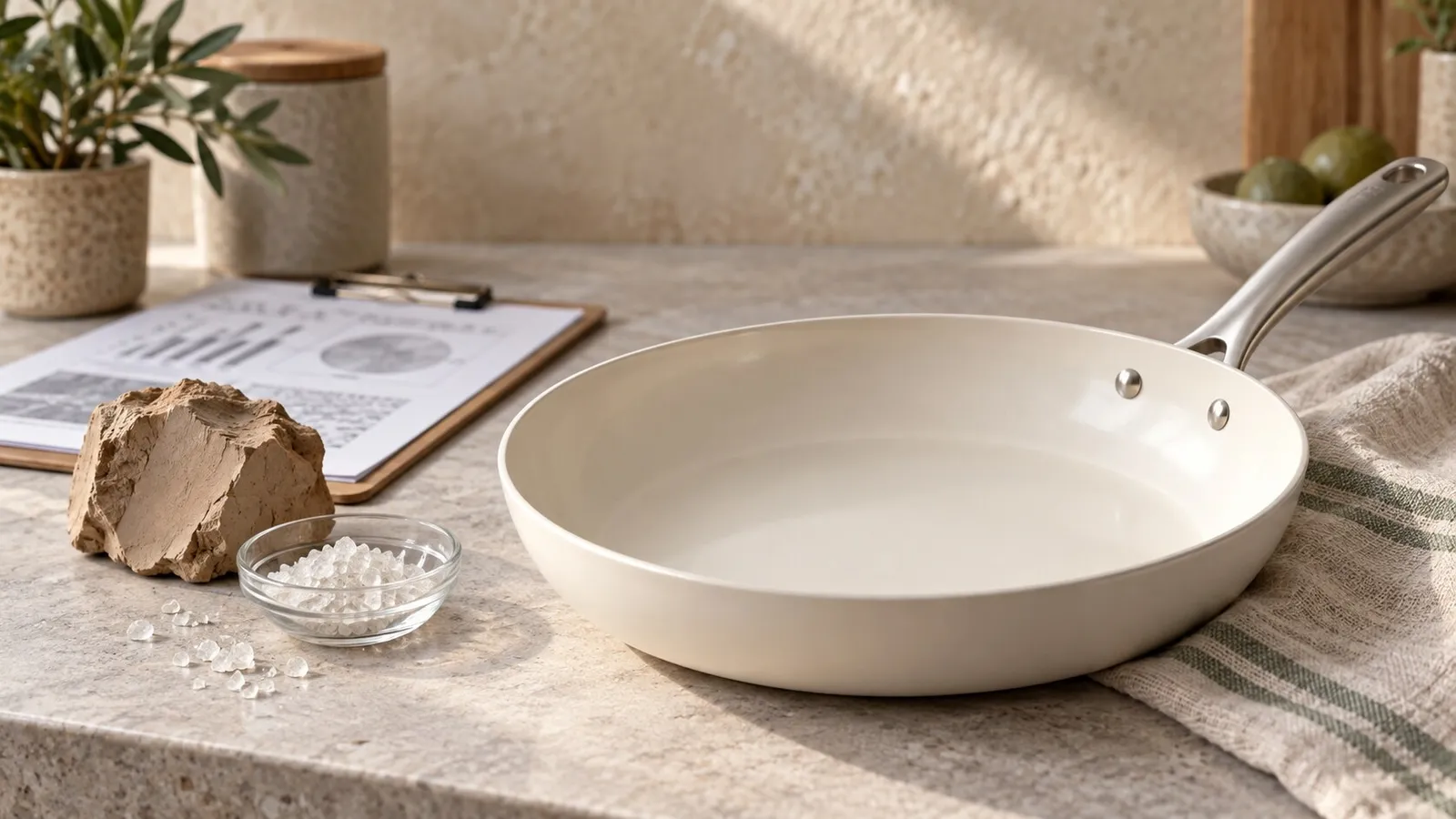
Editorial image for illustration; not a product-testing record or a documented kitchen project.
Some links may earn Zen Kitchen a commission if you buy, at no additional cost to you. Our evaluations are based on published sources. Read our affiliate policy.
A ceramic label does not establish that cookware is universally non-toxic. First identify whether the product is ceramic-coated metal, solid ceramic, or enameled metal. Then check its intended use, formulation claims, and any supporting reports. A claim about one model does not verify every pan marketed as ceramic.
This guide explains how to examine the evidence without equating a marketing label with a laboratory result. We have not conducted original chemical or cooking tests.
| Product description | What it generally describes | First question |
|---|---|---|
| Ceramic-coated metal | A coating on a metal vessel | Which coating claim and care instructions apply to this line? |
| Solid ceramic | A fired ceramic vessel, sometimes glazed | Is this specific vessel intended for food and the heat source you use? |
| Enameled metal | A vitreous surface over a metal body | What does the maker say about condition, handling, and food use? |
Words such as stone, granite, or mineral are not enough to identify a coating. Look for an explicit material description. If the listing is ambiguous, ask for a written answer before buying.
Do not infer PFAS status from the category name alone. A statement about a coating’s formulation needs an identified product and a clear scope. Check whether the manufacturer supplies a report or only a general marketing assertion.
Caraway’s testing page, for example, links supporting material for its stated PFAS claims. That is an example of accessible manufacturer-provided evidence, not our independent verification of the whole ceramic category.
Also distinguish PFOA-free from PTFE-free. The terms are not interchangeable. For the broader material context, see the cookware guide.
A useful report identifies what was examined, when, and how. Read the sample description before the result. A test on a coating, a finished vessel, and a food-contact extract can answer different questions.
| Report detail | Why you need it |
|---|---|
| Product or sample identifier | Connects the result to the item you are considering |
| Method and substances assessed | Shows the question the test was designed to answer |
| Reporting limit | Helps interpret a result stated as not detected |
| Test conditions | Establishes what heating or contact situation was assessed |
| Date | Helps you ask whether the product has changed since testing |
| Lab and issuer | Identifies who performed and published the work |
A nondetection applies to the method’s limits and conditions. Do not rewrite it as proof of absolute zero, a universal health guarantee, or superior cooking performance.
If only an excerpt is available, ask for the missing context. If a report is inaccessible, say the evidence could not be examined rather than claiming it proves a conclusion.
The FDA warns that some traditional lead-glazed pottery can release lead into food. It also explains that labeling and manufacturing practices matter. Decorative or unidentified pottery should not be assumed suitable for food contact.
That guidance should not be stretched into a claim that a particular enamel color is safe or unsafe. Identify the product and intended use. If a handmade or vintage piece lacks clear information, ask before using it for cooking, storage, or serving.
The NAD decision concerning Caraway supported certain advertised claims while recommending changes to some comparisons with traditional cookware. Advertising substantiation is relevant context; it does not certify every ceramic product or settle all questions about household exposure.
An editorial review should explain that distinction. It should not borrow a decision about one advertiser as a numerical safety rating for another brand.
Read the exact instructions for your pan. Check the stovetop guidance separately from oven and lid limits. Consider utensils, cleaning, storage contact, and whether the routine fits everyone who uses the kitchen.
We do not provide a tested lifespan for ceramic coatings. A fixed replacement schedule would require evidence about the actual product and use. Instead, include replacement cost as an uncertainty when comparing a pan with another material.
When performance changes, consult the manufacturer rather than attempt an improvised resurfacing treatment. A different pan for a particular cooking job may be more useful than asking one coated skillet to do everything.
This is an editorial checklist, not a safety certification.
You may finish with an unanswered question. That is useful information. It tells you what to ask the maker instead of encouraging a reassuring conclusion the evidence does not support.
This guide does not establish a universal ranking. Material preferences, intended use, and product-specific evidence differ. Avoid assuming that the presence or absence of one material alone proves the safety of ordinary cooking.
No. The terms describe different constructions. Check the exact vessel’s food-contact and heat-source instructions rather than transfer advice from a coated skillet to pottery.
Color is not a verification method. Product documentation and intended use matter more than a general rule about bright or neutral finishes.
A report can answer a specific chemical question. A buying decision also needs size, handling, care, compatibility, and price. Keep these decisions separate instead of compressing them into a safety score.
Keep reading: Cookware materials · Caraway researched review · Steel versus ceramic · All cookware guides
Sources describe their own scope and limitations. Read our sourcing policy.
Read more from the Non-Toxic Product Curation pillar.
Non-Toxic

Understand cookware surfaces, product claims, and evidence limits. Use a material and evidence worksheet to compare purchases for your kitchen.
6 min read
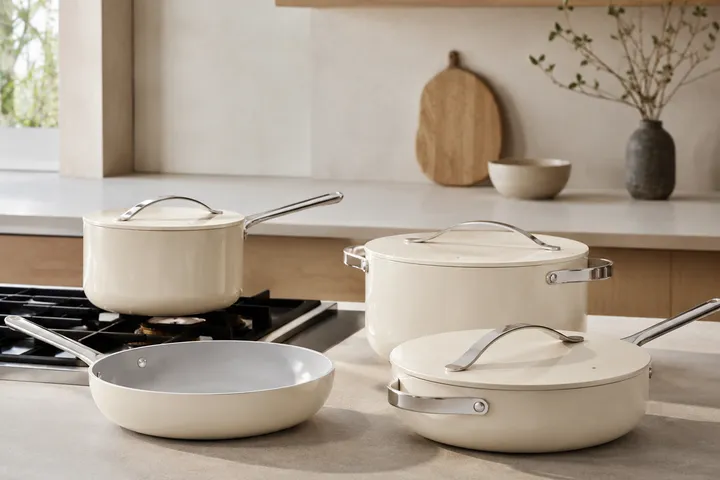
A researched evaluation of Caraway ceramic cookware: published coating claims, care requirements, storage fit, and questions to answer before buying.
7 min read
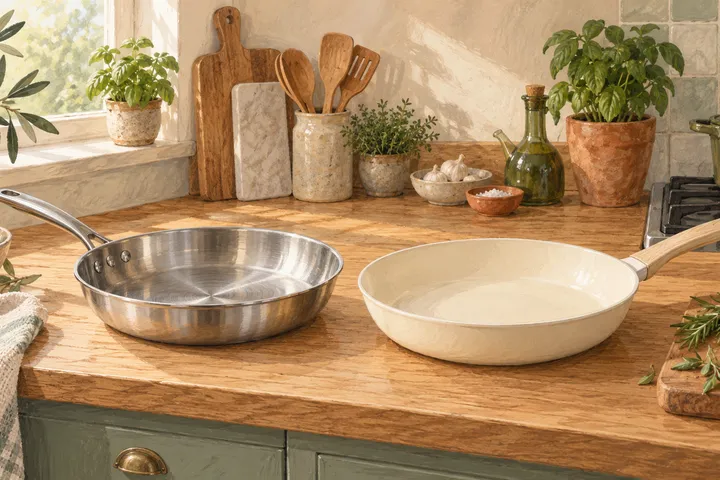
Compare stainless steel and ceramic-coated pans by cooking behaviour, care, coating life and realistic ownership costs.
7 min read