
Carbon Steel vs Cast Iron
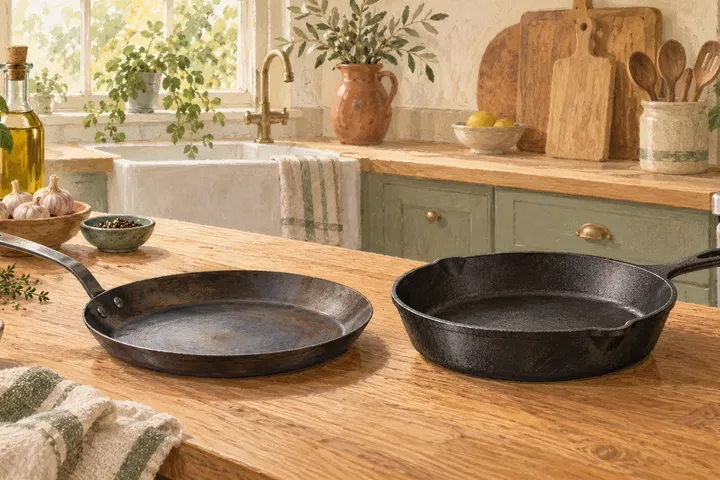
Choose between seasoned carbon steel and cast iron by actual weight, shape, cooking habits and maintenance.
7 min read
Compare stainless steel and ceramic-coated pans by cooking behaviour, care, coating life and realistic ownership costs.
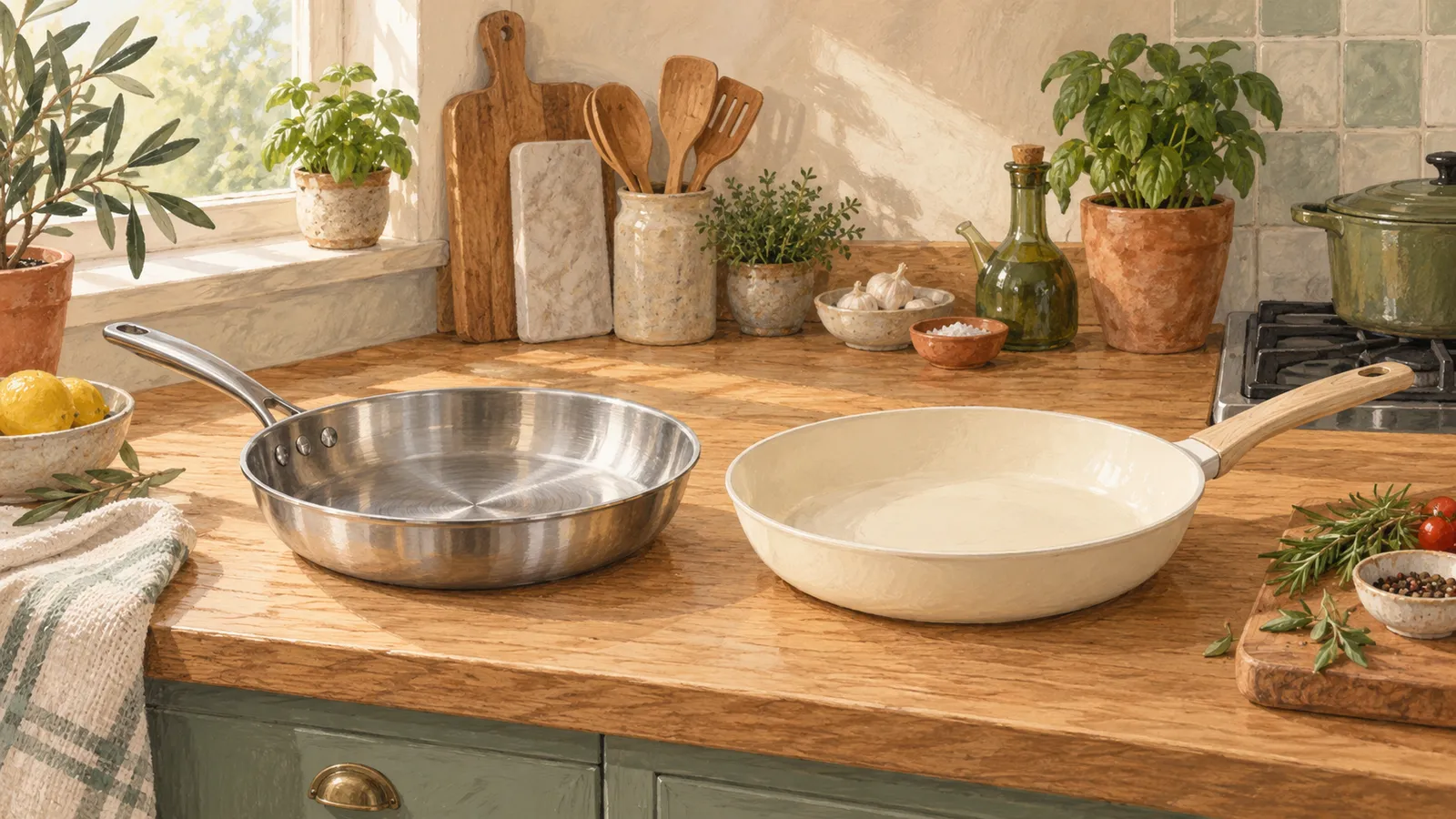
AI-generated editorial illustration; a conceptual scene, not a product photograph.
Uncoated stainless steel suits browning, sauces and years of ordinary cooking. If easy release is your main priority, consider ceramic-coated cookware, allowing for gentle care and eventual replacement if the coating’s performance declines.
A stainless saucepan and a small coated frying pan can serve different jobs in the same kitchen. Start with the meals you cook, then check the exact pan’s construction, hob compatibility and care instructions.
This comparison concerns metal pans with a ceramic non-stick coating. It does not cover solid ceramic bakeware, glazed pottery or every product sold under a ceramic label. Those are different objects with different instructions.
Stainless steel cookware may also have a layered construction. A stainless cooking surface can surround an aluminium core or sit above a bonded base. “Stainless” describes a material, not the entire design or a guarantee of even heating. Look at the base, thickness, handle and permitted heat sources as well as the label.
A ceramic coating is the food-contact surface over a metal pan. The manufacturer’s material statement should identify the coating for the model you are considering. Do not assume that a pale colour, a stone-like pattern or the word “healthy” tells you what the surface contains.
If you are also considering seasoned iron or other materials, the non-toxic cookware guide compares those options.
| Cooking or ownership need | Uncoated stainless steel | Ceramic-coated metal |
|---|---|---|
| Browning and pan sauces | Useful when you want browned residue to deglaze | Easy release may leave less residue for a sauce |
| Eggs and delicate foods | Requires attention to heat, fat and timing | Usually chosen for easier release while coating performs well |
| Acidic sauces | Check exact product instructions; commonly used for sauces | Check coating and care instructions |
| Everyday cleaning | May need soaking for attached food | Gentle cleaning is important to preserve the coating |
| Utensils | Follow manufacturer guidance; uncoated surface has no non-stick layer to scratch through | Soft utensils are the cautious choice unless instructed otherwise |
| Long-term ownership | Handles, base and body condition determine useful life | Body can remain sound while easy-release performance changes |
| Oven use | Depends on handles, lid and model limit | Depends on coating, handles, lid and model limit |
These are typical uses drawn from product guidance; we have not tested these pans. Construction and size can matter as much as the surface: overcrowding a small pan can make browning difficult regardless of material.
Food can attach to stainless steel when the heat, fat or timing is unsuitable. That does not mean the surface is defective. For browning, some attachment is useful: the residue can become part of a sauce when you add liquid and loosen it according to your recipe.
For delicate foods, use a gentler approach. Preheat as the manufacturer directs, add appropriate cooking fat and give food time to set before trying to move it. A pan heated for steak is not automatically at the right temperature for eggs.
All-Clad’s care guidance recommends attention to heat settings and avoiding abrupt cooling of a hot pan. Follow the instructions for your particular range rather than treating every stainless pan as indestructible. A strong induction boost setting can heat cookware very quickly.
Our stainless steel egg guide gives a more detailed starting method and troubleshooting table. If learning that technique sounds worthwhile, stainless steel may fit your routine. If you need the simplest possible breakfast on a rushed morning, a gently used coated pan may be more convenient.
Use the heat and oil instructions supplied with the pan. As one manufacturer example, GreenPan recommends low to medium heat, suitable fat and gentle cleaning. Its advice also includes letting cookware cool before washing and avoiding cooking sprays. Those instructions support care of its products; they do not establish the life of every ceramic coating.
Keep the heat within the pan’s recommended range even when food slides out easily. Burnt-on oil and food residue can also affect performance, so a pan that sticks needs inspection and appropriate cleaning before you decide its coating has failed.
There is no reliable replacement interval that applies to every ceramic-coated pan. Cooking frequency, temperature, cleaning and construction all vary. A fixed lifespan claim tells you little unless it explains how the pan was used and cared for.
Inspect a coated pan for damage and follow its replacement instructions. Do not confuse cosmetic marks, residue and peeling; they are different observations. Ask the manufacturer if the condition is unclear, particularly before trying an abrasive cleaning method.
If avoiding PFAS is part of your buying criteria, look for an explicit statement for the exact coating and model. “PFOA-free” is a narrower claim and does not by itself mean PFAS-free. The German Federal Institute for Risk Assessment explains that PTFE belongs to the PFAS group.
That institute also says adverse health effects are not expected from PTFE cookware used as intended, while warning against severe overheating. Its guidance concerns PTFE, not a certification of ceramic products. Avoiding a material can be a purchasing preference without claiming that every alternative provides a health benefit.
For either type, buy cookware intended for food contact from a supplier able to provide clear instructions. An attractive exterior and a broad “non-toxic” slogan cannot replace model-specific information.
Purchase price is only one part of cost. Consider whether the pan does several jobs, whether replacement lids or parts are available and whether its maintenance fits your habits. A pan you avoid using is poor value even if it might last a long time.
For a hypothetical US-dollar calculation, suppose one pan costs US$100 and you use it for five years. These figures are illustrative prices and ownership periods, not current quotes or a lifespan forecast. The purchase cost averages US$20 a year. If a US$50 coated pan is replaced twice during those same five years, three purchases total US$150, or US$30 a year. If it needs no replacement, the result changes completely.
Use your own local prices and plausible scenarios. Do not present an assumed replacement cycle as evidence. Shipping, import charges and warranty coverage can differ by market, so an overseas sale price may be irrelevant to your decision.
Write down your three most common pan meals. If they are sauces, sautéed vegetables and browned meat or tofu, a well matched stainless pan deserves a close look. If eggs and delicate pancakes dominate, easy release may deserve more weight.
Then handle the pan if possible. Check whether you can lift it, whether it fits your burner and whether its handle leaves enough storage room. Compare carbon steel and cast iron if you want another uncoated option and are willing to maintain seasoning.
Buy one suitable piece before replacing a whole collection. Cook a few familiar meals in it and see whether the weight, cleaning and heat control suit you before buying more pieces.
Sources describe their own scope and limitations. Read our sourcing policy.
Read more from the Non-Toxic Product Curation pillar.
Non-Toxic
Choose between seasoned carbon steel and cast iron by actual weight, shape, cooking habits and maintenance.
7 min read
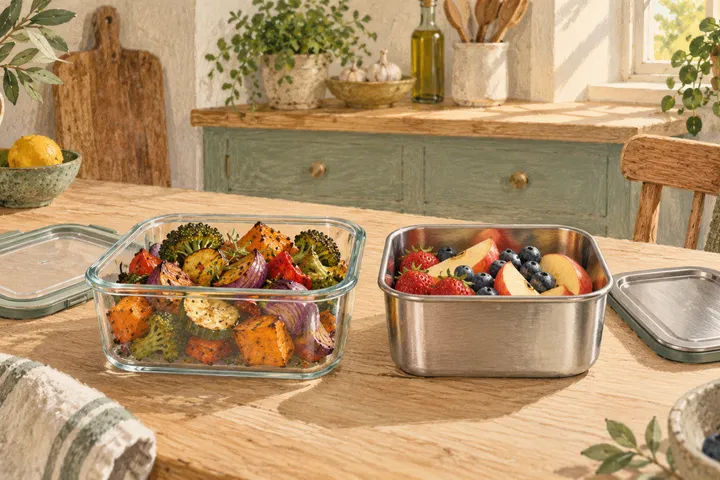
Compare food-container bodies, lids, leaks, carrying weight and exact appliance compatibility before buying a set.
7 min read
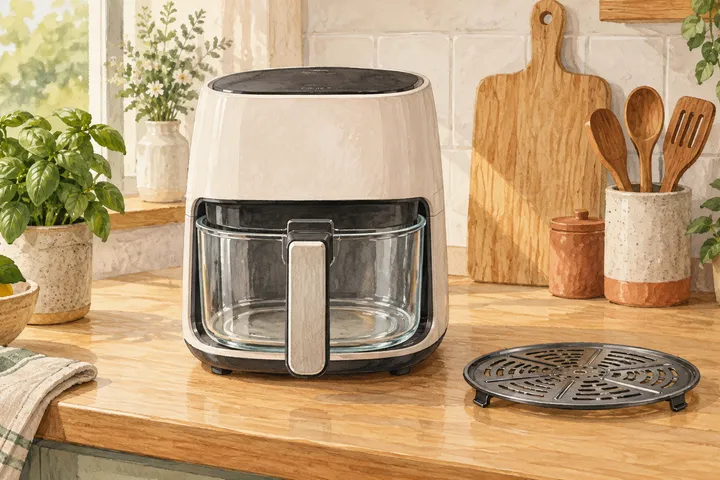
Check exact air-fryer models and food-contact parts, with a researched US shortlist and questions to clarify PFAS-free claims.
6 min read