
Carbon Steel vs Cast Iron
Choose between seasoned carbon steel and cast iron by actual weight, shape, cooking habits and maintenance.
7 min read
Check exact air-fryer models and food-contact parts, with a researched US shortlist and questions to clarify PFAS-free claims.
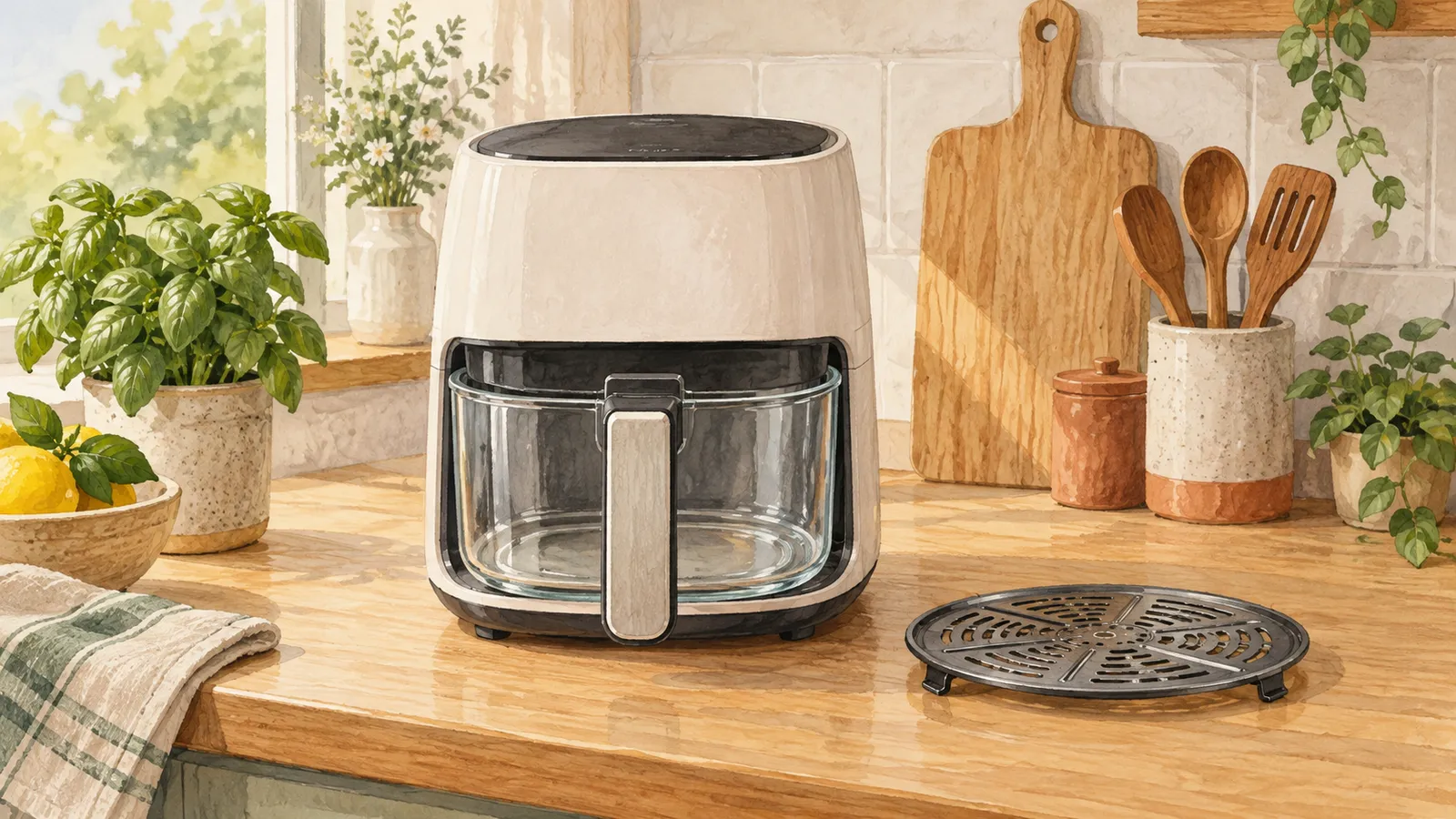
AI-generated editorial illustration; a conceptual scene, not a product photograph.
To choose a PFAS-free air fryer, check the exact model and the disclosure for each food-contact part: the cooking vessel, basket or tray, crisper plate and included accessories. A glass bowl or a stainless steel exterior does not tell you what coats the removable plate inside it. Prefer a clear written statement that names the relevant parts.
This shortlist compares disclosed materials and ownership questions using US manufacturer listings consulted on 11 October 2026. We have not tested the appliances, commissioned chemical analysis or confirmed worldwide availability.
PFAS describes a broad group of substances. Germany’s BfR guidance on PTFE cookware identifies PTFE within that group. BfR says adverse health effects are not expected when PTFE cookware is used as intended, while warning against severe overheating.
“PFOA-free” alone does not establish that a product is PTFE-free or free of the broader PFAS group. Similarly, “non-toxic,” “healthy” and “ceramic” are not complete descriptions of every component. Look for the manufacturer to state what is excluded and where that statement applies.
The non-toxic cookware guide explains the wider material choices. When comparing air fryers, keep the model’s parts list beside its disclosure so you can see which food-contact surfaces are covered.
| Part | Question to ask | Why the answer matters |
|---|---|---|
| Bowl, drawer or basket | What is the base material, and is it coated? | A familiar body material can have an additional coating |
| Crisper plate or insert | What material and coating does it use? | It may differ from the vessel |
| Baking or roasting pan | Is the accessory covered by the PFAS statement? | Included pans can have separate finishes |
| Rack and mesh basket | Is it bare, plated or coated metal? | “Metal” is incomplete information |
| Replacement accessories | Does the disclosure cover this exact replacement? | Accessories can change independently of the appliance name |
Record the model code as well as the range name. A standard, large, pro or regional version may have different parts. Save the relevant product page and manual with the purchase information so that a later replacement can be checked against them.
The capacities below are the manufacturers’ container or cavity ratings. We have not measured usable batch sizes or cooking performance. Approximate metric conversions appear first. The products have different designs, so equal nominal capacity would not establish equal usable space.
| Exact listing reviewed | Disclosed food-contact information | Nominal capacity | Remaining check |
|---|---|---|---|
| Ninja Crispi 4-in-1, FN101ST, Stone | Glass vessels; comparison chart also states PFAS- and PTFE-free cooking surfaces | About 3.8 L and 1.4 L (4 US quarts and 6 US cups) | Confirm individual plate construction and replacement specifications |
| GreenPan Bistro 7-Quart Clear View | Manufacturer explicitly describes the drawer and air-fry tray as PFAS-free ceramic nonstick | About 6.6 L (7 US quarts) | Confirm the exact supplied accessories and local model match the disclosure |
| Our Place Wonder Oven, Standard 12 L | Manufacturer states its interior and included accessories are made without PFAS, including PTFE | 12 L cavity (about 12.7 US quarts) | Check the Standard version and any separately purchased accessories |
The US FN101ST listing describes two glass vessels and two supplied crisper plates. Alongside its glass claim, the model comparison chart states that the cooking surfaces are PFAS- and PTFE-free. The statement does not separately describe the plates’ complete construction.
If you require a part-by-part material specification, ask Ninja about the two supplied plates and their replacements. Treat the exclusion statement as a manufacturer claim, rather than independent chemical testing. Do not infer plate composition from the glass bowl or apply a newer Crispi model’s construction details to FN101ST.
The detachable heating unit also creates a storage question. Set aside storage for the heating unit, spare vessel and plates as well as the bowl you use most often. A compact cooking vessel can still form a relatively large collection of parts.
The Bistro 7-Quart Clear View listing explicitly identifies PFAS-free ceramic nonstick on its drawer and air-fry tray. The statement names those two parts. We have not independently tested the materials in the appliance.
Read the instructions for utensils and cleaning to judge whether caring for the coating fits your routine. Also check whether you can buy a replacement tray if it wears or is damaged.
Check the space needed to pull the drawer fully forward, including the landing area for handling it safely. Do not judge countertop fit from the closed appliance alone.
The Standard 12 L Wonder Oven listing gives a broader manufacturer statement covering the interior and included accessories. It describes a stainless steel interior, a chromed steel air-fry basket and an aluminium baking pan with a ceramic coating. The materials are not all identical even though the PFAS statement covers the included collection.
An oven format may suit someone who wants shelves and several cooking modes, but the door and accessories need working space. Compare the supplied basket’s usable dimensions with the foods you normally prepare. A 12 L cavity rating does not mean a 12 L basket.
Do not transfer this information to the Large or other Wonder Oven variants without checking their own disclosures. These details come from the Standard listing.
Use this checklist when a listing leaves gaps:
Keep the reply with your purchase records. If it does not answer the part-specific question, treat that point as unresolved rather than filling the gap with a retailer’s generic description.
Check electrical compatibility and the local manual in your market. US listings do not establish suitability for other voltages, plugs or regional versions. For a purchase outside the US, compare the locally sold model’s materials, price and warranty before ordering.
Use the manufacturer’s placement and ventilation instructions. A drawer fitting under a wall cabinet does not establish safe operating clearance. Keep the instruction-defined space available whenever the appliance is running.
For coated parts, the care comparison in stainless steel vs ceramic cookware helps frame ownership questions. For daily prep around the appliance, wood vs plastic cutting boards covers a separate materials decision. Before buying, make sure each food-contact part has a clear specification and that you have room to open, use and clean the appliance comfortably.
Sources describe their own scope and limitations. Read our sourcing policy.
Read more from the Non-Toxic Product Curation pillar.
Non-Toxic
Choose between seasoned carbon steel and cast iron by actual weight, shape, cooking habits and maintenance.
7 min read
Compare food-container bodies, lids, leaks, carrying weight and exact appliance compatibility before buying a set.
7 min read
Use gentle heat, suitable fat and patient timing for stainless steel eggs, with a practical troubleshooting table.
6 min read