
Carbon Steel vs Cast Iron
Choose between seasoned carbon steel and cast iron by actual weight, shape, cooking habits and maintenance.
7 min read
Compare wood and plastic cutting boards by cleaning, knife use, drying, storage and replacement, with a practical decision table.
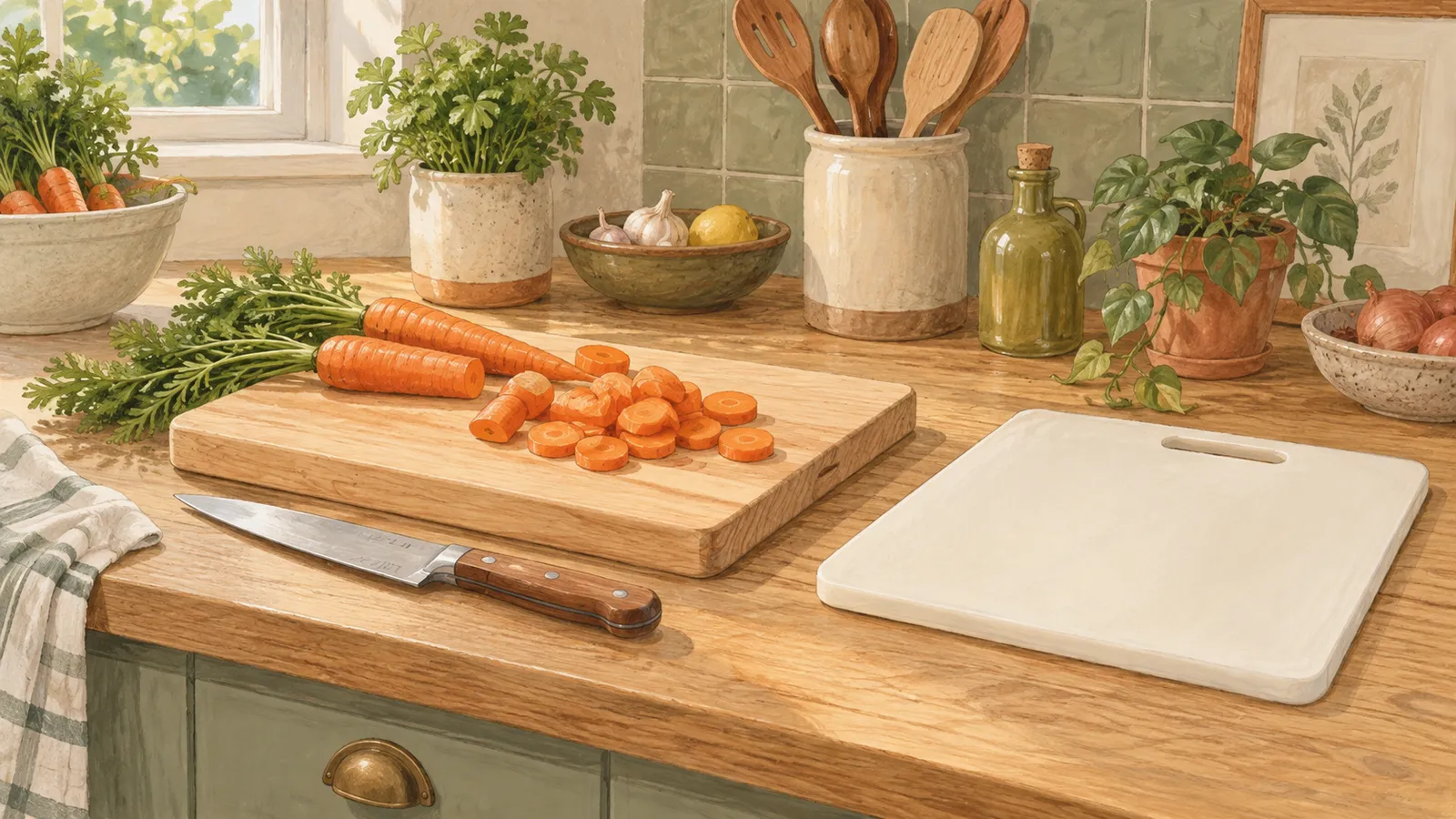
AI-generated editorial illustration; a conceptual scene, not a product photograph.
A wood cutting board can suit you if you enjoy its working surface and can follow the maker’s care instructions. Plastic may suit you better if a lighter board and a permitted dishwasher cycle make daily cleaning easier. For many kitchens, one board for produce and bread and a separate board for raw meat, poultry or seafood is more useful than choosing one material for everything.
Whichever you choose, plan how you will clean, dry and store it, and replace it when wear makes cleaning difficult. The non-toxic cookware guide offers a similar approach to choosing other kitchen materials by their use and care.
| Question | Wood | Plastic |
|---|---|---|
| How will I clean it? | Follow the exact construction’s instructions; hand washing is a common requirement | Check dishwasher permission, rack position and temperature limits |
| Can I lift and store it easily? | Thick boards can be substantial | Often available in thin, light formats; check stability |
| How does it feel under a knife? | Suitable cutting-board woods can provide a comfortable surface | Suitable food-use plastics also work well; feel varies by product |
| What maintenance is needed? | Drying and any specified conditioning | Cleaning, drying and checking for wear or distortion |
| When should I replace it? | Hard-to-clean grooves, splits or other damage need attention | Hard-to-clean grooves, cracks or distortion need attention |
| Is raw-food separation automatic? | No | No |
We have not tested these boards; the comparison draws on food-safety and care guidance. A thin flexible plastic mat and a thick commercial board behave differently, just as a small solid wood board differs from a heavy laminated block.
The US USDA cutting-board guidance allows wood or a nonporous board for raw meat and poultry. It recommends separating boards used for raw meat, poultry and seafood from those used for produce and bread, and replacing excessively worn boards or boards with hard-to-clean grooves.
Assign each board a clear job. Different colours, shapes or storage positions can help people remember. Explain the assigned jobs to everyone who cooks, and clean each board after use.
If a kitchen has only one board, changing jobs requires appropriate cleaning before ready-to-eat food touches it. A second suitable board can make that separation easier during a busy meal. Store the boards so that a dirty one does not contact a clean one.
Wash and, where needed, sanitize according to authoritative guidance and the board’s material instructions. Michigan State University Extension distinguishes cleaning from sanitizing after raw meat, poultry or seafood and advises an approved sanitizer at the correct concentration. Follow the product’s food-contact directions, including rinsing if specified. Sanitizer concentrations differ, so use the dilution on the label rather than a recipe intended for another product.
Some guidance permits dishwasher washing for certain solid wood boards, while many manufacturers restrict their wood products to hand washing. Construction, adhesive joints and finish matter. Follow the instructions for your board rather than treating a broad material category as permission.
Likewise, not every plastic board tolerates every dishwasher programme or position. Check before using a high-temperature cycle or placing it near a heating element. A board that warps can become awkward or unstable even if its surface looks clean.
If dishwasher convenience is the reason for choosing plastic, make that specification part of the purchase. Find a board that fits the rack correctly and can be removed and stored comfortably. A board too large for your dishwasher may not offer the convenience you expected.
Both appropriate wood and plastic boards can provide practical knife surfaces. MSU Extension notes that glass and stone dull blades quickly compared with wood or plastic. Keep a glass serving slab separate from the board you use for chopping.
Do not assume every wooden object is a cutting board. Select a product intended for food preparation, with suitable wood, construction and care directions. Decorative serving pieces may not be designed for repeated knife work.
Knife feel varies. Some people prefer the resistance of a thick wood board; others like a light plastic board they can move between tasks. Compare dimensions, stability and your own handling. Knife wear varies, so neither material guarantees that every knife will stay sharp longer.
Use a stable board on a suitable surface. If it slips, address that before chopping. MSU describes placing a clean damp towel beneath a board as one option; purpose-made nonslip features may also help when used as directed. Keep the support clean and avoid hiding an unstable, warped board beneath it.
Hand-wash a wood board as directed, then allow it to dry appropriately before enclosed storage. Do not leave it soaking while you finish the rest of the dishes. Leave room for air around it so moisture is not trapped between boards.
The University of Maine Extension’s board-care guidance discusses washing, drying and suitable maintenance for wood boards. Where conditioning is recommended, use the product specified for food-use boards by the manufacturer. Cooking oil is not automatically an appropriate substitute for the recommended treatment.
A large board can be pleasant to work on but difficult to wash in a small sink. Before buying, simulate lifting and turning a similarly sized object. Consider the full route from cupboard to counter to sink to drying position.
| What you find | Useful response |
|---|---|
| Shallow normal knife marks on an otherwise sound board | Continue appropriate care and inspect regularly |
| Deep grooves that are difficult to clean | Replace according to food-safety guidance |
| Split wood, loose joints or cracks | Stop using the damaged food-preparation surface; consult the maker or replace |
| A board that rocks or slides because it is distorted | Replace or obtain a manufacturer-approved remedy |
| Unclear food-use status or missing care information | Verify suitability before making it your everyday chopping board |
A repairable wood board may have options that a thin plastic board does not, but home sanding is not a universal solution. Construction and remaining thickness matter. Ask the maker whether repair is suitable before sanding a worn board and returning it to food preparation.
In this hypothetical arrangement, a cook uses a manageable wood board for vegetables and bread and a separate dishwasher-approved plastic board for raw animal foods. Both stand in an accessible divided space once clean and dry. The knife has its own safe storage position.
Allow enough drying space for both boards before choosing their sizes. Someone who does not prepare raw animal foods may choose a different arrangement; separation still matters whenever food or equipment could contaminate ready-to-eat ingredients.
For nearby equipment, compare glass and stainless steel containers. For the cupboard itself, pots and pans in a small kitchen includes upright storage checks that also help with board access. Choose the board you can clean, handle and maintain reliably, and make room for that care in the daily routine.
Sources describe their own scope and limitations. Read our sourcing policy.
Read more from the Non-Toxic Product Curation pillar.
Non-Toxic
Choose between seasoned carbon steel and cast iron by actual weight, shape, cooking habits and maintenance.
7 min read
Compare food-container bodies, lids, leaks, carrying weight and exact appliance compatibility before buying a set.
7 min read
Check exact air-fryer models and food-contact parts, with a researched US shortlist and questions to clarify PFAS-free claims.
6 min read