
How to Organize a Kitchen With No Pantry
How to keep a pantry-free kitchen calm and functional — using cabinet interiors, vertical wall space, and a strict decant-and-edit system to replace the storage a pantry would normally give you.
Clear your kitchen counters without the cold, empty look. A step-by-step guide to decluttering counters and keeping them warm, with a real before-and-after and a short list of what to actually keep out.
Last updated: June 2026. This guide has no affiliate links. When we recommend a product, we’ve used it first.
Clearing your kitchen counters does not have to leave them cold or clinical. To declutter kitchen counters without it feeling bare, take everything off, keep only what you reach for daily, give the rest a home inside your cabinets, and then put back one warm, natural object per zone. The emptiness people dread comes from missing texture, not missing clutter. Fix the texture and a clear counter reads as calm instead of stripped.
That last part is the whole trick, and almost every “declutter your counters” guide skips it. They tell you what to remove. Nobody tells you what to leave so the room still feels like yours.
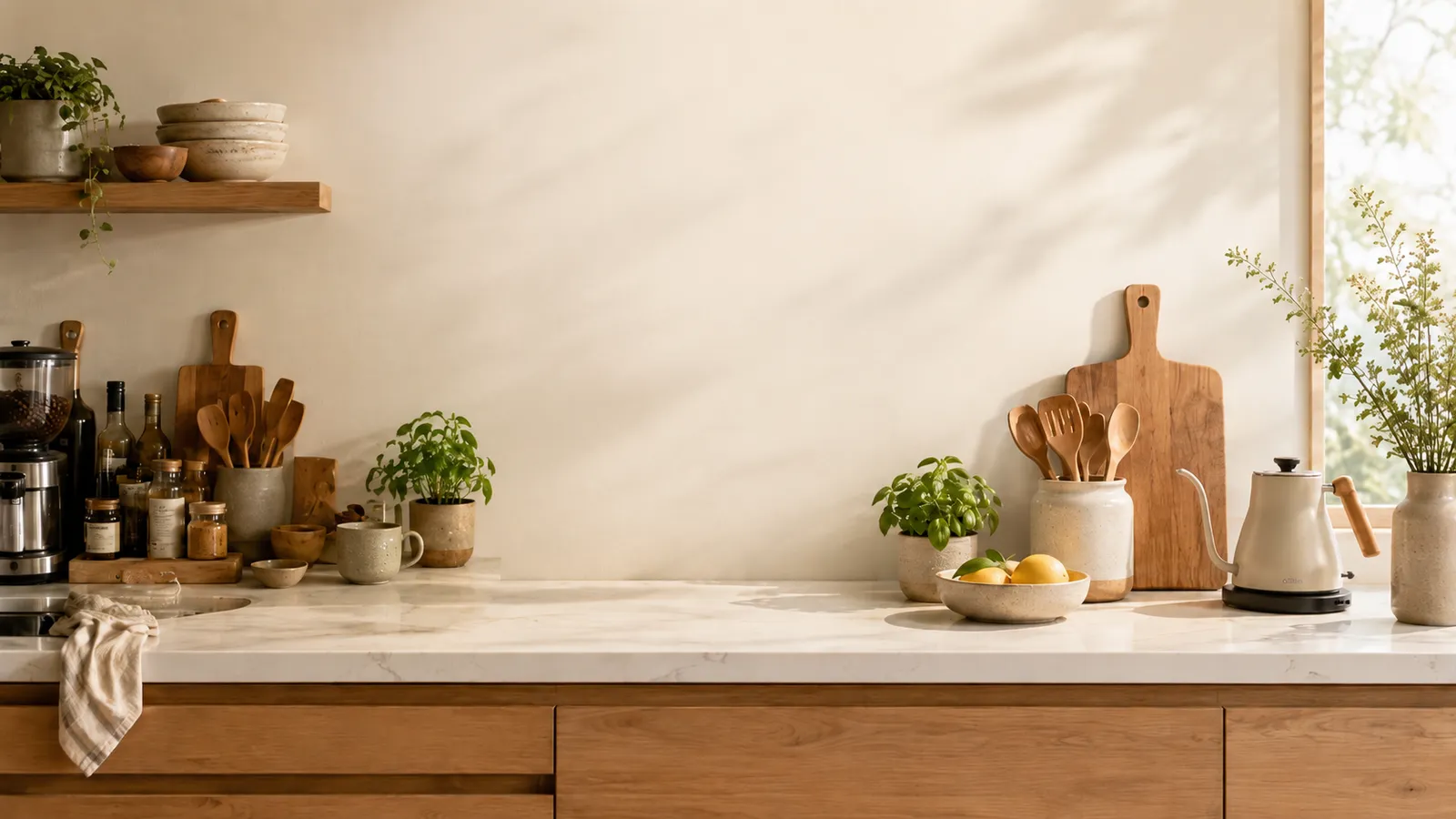
What earns a spot on the counter: the appliance you use every day, a single utensil crock or knife strip if you cook daily, and one object with warmth in it. A wooden board, a bowl of lemons, a small herb in a pot. Everything else has a better home a cabinet door away.
A bare counter feels cold when you strip everything off and put nothing back. The fix is not to keep the clutter. It is to add back a small amount of warmth on purpose.
There is a real reason “empty” reads as “cold.” When designers talk about minimalism going wrong, they almost always mean a surface that lost its texture. Wood, stone, ceramic, and linen carry visual warmth that gloss and bare laminate do not. Wood also has low thermal conductivity, so it does not even feel cold to the touch the way steel or tile does. Strip all of that out and you get a room that looks tidy and feels like a waiting room.
This is the heart of the Japandi look that has been everywhere in 2026 kitchen design. Interior designer Courtney Cole described the trend to The Kitchn as striking the balance between warmth and minimalism, which is a polite way of saying clear the clutter but keep the soul. You do that with one considered object per zone, soft 2700K to 3000K lighting instead of cold white, and at least one natural material in view.
So the goal is not a counter with nothing on it. It is a counter with nothing unintentional on it.
Counter clutter is not only an eyesore. It taxes your attention and your time in ways you stop noticing because you live with it.
Your brain treats every object in view as something to process. In a 2011 fMRI study at the Princeton Neuroscience Institute, McMains and Kastner found that multiple objects in the visual field compete for representation and suppress each other, which leaves your visual system with less capacity for the thing you are actually trying to do. In plain terms, a crowded counter makes it harder to focus on the one task in front of you.
It may follow you home emotionally too. A UCLA study of dual-income families (Saxbe and Repetti, Personality and Social Psychology Bulletin, 2010) found that the people who described their homes as cluttered and unfinished tended to show flatter daily cortisol patterns, a profile linked to higher stress. The effect showed up mainly in the women, who in the recordings were the ones narrating the mess.
Then there is the plain arithmetic of looking for things. People lose roughly ten minutes a day hunting for misplaced items at home, according to lost-item survey data summarised by Attic Self Storage. A counter buried under mail and gadgets is where a lot of that time goes.
And most of the gadgets are not even earning their footprint. A 2025 YouGov survey of 1,000 US adults found the drip coffee maker is the only appliance most owners use weekly, at 62 percent. The ice cream maker sits idle for about a fifth of owners, who use it less than once a year. Waffle makers and dehydrators are not far behind. The same survey found 62 percent of Americans say they have little or no space left for more appliances, which makes sense when the rarely-used ones never leave the counter.
The order matters here. Sort before you store, and add warmth back last, once you can see the clean surface you are working with.
Take everything off first. Professional organizer Melissa Gugni tells clients to clear the counters completely before deciding anything, because you cannot judge what belongs there while it is still sitting there (Homes & Gardens). Wipe the empty surface down. This is your baseline.
Sort by how often you actually use it. Organizer Amélie Saint-Jacques’ rule, via Real Homes, is blunt: only items used on a daily basis stay on the counter. For everything else, ask whether you have used it in the last six months. If not, it does not get prime real estate.
Give the rest a real home. Relocate by category instead of shoving things in the nearest cabinet. Daily appliances you want hidden go in an appliance garage or a deep base drawer. Knives move to a wall-mounted magnetic strip. Oils and spices go on a turntable inside a cabinet. Dry goods get decanted into matching jars in the pantry. Seldom-used machines (the bread maker, the juicer) can live in a laundry room or the back of a low cabinet.
Set up zones around how you cook. Group what is left by task so the daily items live where you use them. Coffee maker near the mugs and the kettle. A small prep zone by the cutting board and the bin. Putting things at their point of use is what keeps a clear counter from quietly refilling.
Add the warmth back, on purpose. This is the step that answers “won’t it look empty?” Put back one natural element per visible zone and stop there. A wooden board leaned against the backsplash. A single potted herb by the window. A ceramic crock of the utensils you reach for most. Warm the light to 2700K to 3000K. The room now reads as lived-in rather than bare.
Run a one-minute reset every night. Author Di Ter Avest’s habit is to spend a minute before bed putting back anything that drifted onto the counter during the day. Without this step, every counter refills within about two weeks. With it, the work you just did holds.
Keep the items you use daily, plus one object that adds warmth. For most people that comes to four or five things total, not the fifteen-plus that tend to accumulate.
A useful filter: if you would not get it out of a cabinet at least once a day, it does not need to sit out. A toaster you use on weekends only lives below. The stand mixer you run twice a month lives below. The coffee maker, if you brew every morning, has earned its spot.
We score the kitchens we work on against our Calm Kitchen Index, and the counter line item is simple. Clear working surface should be the majority of the counter, every item out has a daily reason to be there, and there is at least one natural material in view. Hit those three and the counter passes whether it holds three things or six.
A clear counter is not the goal. A calm one is. The difference is one object you chose on purpose and the discipline to stop there.
Here is what the change tends to look like in practice. The figures below are an illustrative composite from the galley kitchens we see most often, not a single measured household, but the magnitudes are realistic for a counter of about 14 linear feet (roughly 30 square feet, the US average).
| Metric | Before | After |
|---|---|---|
| Items kept on the counters | 19 | 5 |
| Clear working surface | ~40% | ~80% |
| Daily time spent searching for moved items | ~10 min | ~3 min |
| Time to wipe the counters down | ~6 min | ~90 sec |
| Natural materials in view | 0 | 2 |
The “before” counter held a coffee maker, kettle, toaster, blender, knife block, two spice racks, a paper-towel stand, a vitamin cluster, a mail pile, a cookbook stack, and assorted odds and ends. The “after” kept the coffee maker and kettle, moved the toaster and blender into a base drawer, swapped the knife block for a wall strip, and added a small olive-wood board and a pot of basil. Same kitchen. It just stopped shouting.
We have reset a lot of counters, and the pattern is always the same. The sorting is the easy, satisfying part. People love a cleared surface for about a week.
The part that decides whether it lasts is the nightly minute. It is unglamorous and easy to skip, and it is the single thing that separates a counter that stays clear from one that is back to a mail pile by month’s end. If you only adopt one habit from this guide, adopt that one.
One honest drawback worth naming: a genuinely minimal counter means a little more opening and closing of cabinets. You trade thirty seconds of reaching for a calmer room. For most people that trade is obvious. If you bake daily and resent putting the mixer away, keep it out and own that choice. The system bends to how you cook.
How do I declutter my counters without it feeling empty? Clear the working surfaces completely, then add back exactly one warm, natural object per zone. A wooden board, a small plant, or a ceramic crock. The cold, bare look comes from removing texture, not from removing clutter, so you put the texture back deliberately.
What should I keep on my kitchen counter? Only what you use daily, plus one object with warmth in it. For most kitchens that is the coffee maker or kettle, a utensil crock or knife strip if you cook daily, and a single plant, board, or bowl.
How do I keep counters clear in a small kitchen? Go vertical and go hidden. Use a magnetic knife strip and under-cabinet hooks, store appliances in a base drawer or appliance garage, and apply a strict “use it weekly or it lives elsewhere” rule. In a small kitchen, counter space is the asset you protect first.
Where do I put my coffee maker, toaster, and knife block? The coffee maker stays out if you brew daily. A toaster you use a few times a week is better off in a cabinet or appliance garage and lifted out when needed. The knife block frees up the most space by moving to a wall-mounted magnetic strip.
How do I stop my counters from getting cluttered again? Run a one-minute reset each night, keep a single small tray for the things that always wander in (keys, mail), and follow a one-in-one-out rule when new gadgets arrive. Clutter returns through small daily drift, so the fix is a small daily habit.
Is it bad to have nothing on your kitchen counters? No, but a fully bare counter can feel cold and unwelcoming. The sweet spot is mostly clear with one or two intentional, natural objects in view, which keeps the room calm without making it look unused.
How many items should be on a kitchen counter? Aim for three to five intentional items across the whole counter, with one per zone. Past that, the surface starts competing for your attention and the calm effect breaks down.
You can do most of this with what you already own. The few categories that genuinely help are a magnetic knife strip, a drawer divider or two, a turntable for inside a cabinet, and one good utensil crock. Skip the matching 40-piece organizing kit. Buying more storage to hold things you do not use is just clutter with a label on it.
If you want a printable version of the keep-or-relocate test, it is included in the Minimalist Kitchen Essentials Checklist from our main guide.
Keep reading: The Complete Guide to a Minimalist Kitchen · Small Kitchen Organization Ideas · How to Organize a Kitchen With No Pantry
Last updated .
Read more from the Minimalist Kitchen Living pillar.