
How to Organize a Kitchen With No Pantry
How to keep a pantry-free kitchen calm and functional — using cabinet interiors, vertical wall space, and a strict decant-and-edit system to replace the storage a pantry would normally give you.
A minimalist kitchen isn't an empty one. Here's how to build a calm, intentional kitchen that still works hard for people who actually cook every day.
Last updated: June 2026. Some links below are affiliate links. If you buy through them we may earn a small commission, at no extra cost to you. We only point to things we’d keep in our own kitchens.
A minimalist kitchen is an intentional one, not an empty one. Every tool, surface, and ingredient in it earns its place by being used. For people who cook every day, that’s the whole point: you take out what gets in the way so the things that matter can work harder. A sparse kitchen leaves you under-equipped, reaching for a pan you gave away. A minimalist kitchen leaves you right-equipped, with nothing between you and dinner.
That distinction is the thing most “minimalist kitchen” advice misses. The internet is full of kitchens that look minimal in a photo and would be miserable to cook in. This guide is for the other kind of person: someone who actually uses the stove, most nights, and wants the room to feel calm without feeling bare.
Here’s how to get there.
A minimalist kitchen is one where everything you own gets used and everything you use has a home. That’s it. The number of items doesn’t matter as much as the ratio of useful to dead weight.
The confusion comes from where the idea started. As food writer Ashley Dotterweich points out, kitchen minimalism “has its roots as an aesthetic choice, not a culinary one.” So most advice optimizes for how the room photographs, not how it cooks. Her fix is the better frame: minimalism should be about what’s inside the cupboard, not what it looks like, and about cultivating gear you actually use.
Joshua Becker, who built Becoming Minimalist into one of the most-read voices on the subject, describes minimalism as the intentional promotion of what you value and the removal of what distracts from it. His shorthand is worth taping inside a cabinet door: own less so you can live more. Applied to a kitchen, that isn’t a vow of poverty. It’s permission to keep the cast-iron pan you love and let go of the avocado slicer you bought once.
A few myths worth killing off before we go further.
Minimalism is not deprivation. A daily rice-eater keeps the rice cooker. A serious baker keeps the stand mixer. The test is never “is this technically essential,” it’s “does this earn its place in how I actually cook.” There is no minimalist judge coming to count your forks.
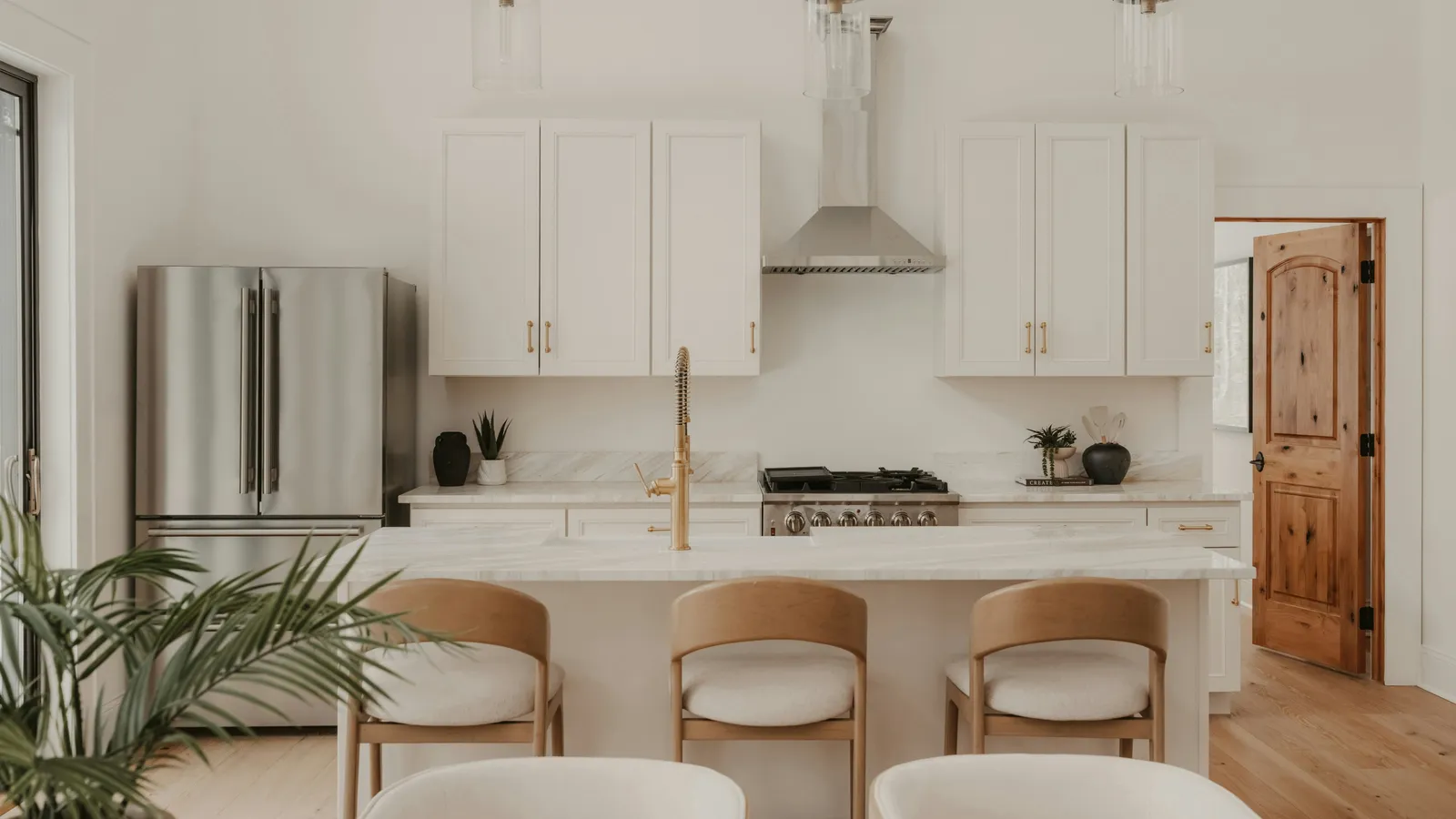
Minimalism is not cold or sterile. We’ll get to this in detail, but the design world has already moved on from the all-white box. Warm beats clinical now, and a calm kitchen can be full of wood, plants, and the one beautiful object you reach for every day.
And minimalism is not anti-cooking. If anything, a pared-down kitchen is easier to cook in, because you’re not excavating a drawer of gadgets to find the one good peeler.
The hard part of any minimalist kitchen is drawing the line between what stays and what goes. A few rules make it less of a gut decision.
The 30-day use test. Put everything in cabinets and drawers, out of sight. Over the next month, take an item out only when you actually use it. Whatever’s still hidden at the end of 30 days is a strong candidate to leave. It’s slower than a one-afternoon purge, but it replaces opinion with evidence.
The convenience trap. We tell ourselves the toaster lives on the counter because we use it daily. In reality it works for about three minutes at breakfast and then sits there for the next twenty-three hours and fifty-seven. “Daily use” and “deserves prime counter space” are two different questions. Most small appliances belong in a cabinet you can reach, not on permanent display.
The 48-hour pause before buying. New gear is how clutter sneaks back in. Before any kitchen purchase, ask whether something you already own can do the job, then wait two days. Most of the time the urge passes, or you realize the chef’s knife already handles it.
Multi-function beats single-purpose, almost always. This is the rule that lets a small kitchen still cook anything. One good pan that sears, sautés, and goes in the oven replaces three mediocre ones. An immersion blender does the work of a full blender and a food processor for most weeknight jobs. Buy fewer things that each do more.
The clutter culprits are remarkably consistent from kitchen to kitchen: electric uni-taskers like the quesadilla maker and egg cooker, single-job gadgets like the apple corer and garlic press, duplicates of cookware you only need one of, and the novelty appliances that get used once a year. Nobody needs three cheese graters. You probably don’t need two vegetable peelers.
If you want a name for where kitchen design is heading in 2026, it’s “Cleaning Therapy.” The surface-maker Cosentino coined the term for a design approach built around visual calm, cleanliness, and wellbeing through durable, low-maintenance materials. In practice it means clean finishes with minimal visual noise: joints that are almost invisible, smooth transitions between surfaces, sinks integrated into the counter, induction hidden beneath it. The fewer interruptions your eye has to process, the calmer the room reads.
There’s a “Total Look” idea inside it too: run the same material across the worktop, the splashback, and the breakfast bar, and the visual seams disappear. Cosentino’s own point is that this also makes a small kitchen feel larger. Less to look at, less to clean, fewer decisions.
What’s striking is how firmly the rest of the industry has turned against the sterile version of minimalism. The era of stark white, ultra-clinical kitchens has, as one 2026 remodel forecast puts it, “gracefully stepped aside” in favor of warm minimalism: the same clean lines and uncluttered silhouettes, but with texture, warmth, soft taupes, creamy ivories, and muted clay tones. In a Homes & Gardens survey of designers, several said cool, blue-toned whites now read as harsh and can flatten the warmth of natural materials. Sage green and warm wood are where the energy is.
Even Pantone leaned this direction. Its 2026 Color of the Year, announced in December 2025, is “Cloud Dancer,” a soft, billowy near-white the company frames as a statement of simplification and quiet reflection. It’s the first time in the program’s history that Pantone has picked a shade of white. Read it as a cultural signal: people want their rooms to feel like a deep breath.
The throughline of all of this is the same one running under minimalism itself. Calm isn’t the absence of stuff. It’s the absence of noise.
The wellbeing claim around minimalist kitchens usually gets hand-waved, so it’s worth being precise about what the research does and doesn’t show.
Start with the UCLA Center on Everyday Lives of Families, which spent years photographing and measuring the homes of 32 dual-income Los Angeles families for its “Life at Home” project. The numbers are vivid. The average refrigerator surface held 52 objects; the most crowded held 166, with magnets, photos, and paper covering up to 90 percent of the door. Only a quarter of the families could fit a car in their garage, because the rest had filled it with belongings. Clutter, it turns out, is the normal state of the American home, not the exception.
The CELF researchers also measured stress directly. In a related study, Darby Saxbe and Rena Repetti analyzed how people described their own homes and matched it against their cortisol, the body’s main stress hormone (full paper here). Wives who described their homes using words like cluttered and unfinished tended to show a flatter daily cortisol pattern, a profile linked to worse stress recovery, and their mood drifted lower over the course of the day. Those who described restful, restorative homes showed a healthier pattern. Two honest caveats, because this study gets misquoted constantly: it shows a correlation, not proof that clutter causes stress, and the effect was significant for women in the sample, not men. Still, the direction is hard to ignore.
Then there’s the attention cost. A Princeton Neuroscience Institute study (McMains and Kastner, in the Journal of Neuroscience) found that when several things compete in your visual field at once, they suppress each other’s representation in the brain. Plain version: a cluttered counter makes it measurably harder to focus, because your visual system is busy fighting over what to look at. Clear the surface and you hand that attention back to the task in front of you, which in a kitchen is a hot pan and a sharp knife.
Add to that the commonly cited estimate that adults make somewhere around 35,000 decisions a day. Most are tiny, and a chaotic kitchen quietly adds to the pile: which drawer, which of the four spatulas, where did the lid go. Every visible object is a small open question. Fewer objects, fewer questions.
None of this means a tidy kitchen will fix your life. It means the calm you feel in a well-ordered kitchen is real, and there’s a reason for it.
Most kitchen advice grades a room on how it looks. That’s exactly the trap we’re trying to avoid, because a beautiful showroom kitchen can be useless to cook in. So we built our own scorecard, and we reference it across the whole site: the Calm Kitchen Index.
It scores a kitchen across six dimensions, zero to ten each, for a total out of 60. The point isn’t the number. It’s that one of the six dimensions is pure function, which means a kitchen that looks calm but cooks badly cannot score full marks. That’s the difference between this and a Pinterest board.
| # | Dimension | What it measures | Low score (0–2) | High score (9–10) |
|---|---|---|---|---|
| 1 | Visual noise | How much competes for your eye on counters and open shelves | Counters fully covered | Three or fewer intentional items on display |
| 2 | Functional efficiency | Whether you can cook your real repertoire easily, with tools near where you use them | Constant cross-kitchen hunting | Every task’s tools within one step |
| 3 | Material and color calm | Cohesive, low-maintenance surfaces and a warm, settled palette | Clashing finishes and loud labels everywhere | Seamless surfaces, warm neutral palette |
| 4 | Essential-to-excess ratio | The share of what you own that you actually use | Drawers won’t close | Almost zero unused gadgets or duplicates |
| 5 | Maintenance load | How easily the whole room resets and cleans | Permanent backlog of mess | A full reset in under ten minutes |
| 6 | Sensory calm | Light, sound, and air quality in the space | Dark, noisy, stale | Bright, quiet, fresh |
Add up your six scores:
Score yours honestly, then come back to it after a month. Dimension 2, functional efficiency, is the one most people overlook and the one serious cooks feel every single day.
Organization is where minimalism either works or quietly falls apart. The goal is a room where everything has a home, that home is near where you use it, and resetting takes minutes.
Work in zones, not piles. The old “kitchen work triangle,” connecting sink, stove, and fridge, was developed back in 1944 by the University of Illinois Small Homes Council to cut down the steps a cook takes. The modern version splits the room into five or six zones: food storage, everyday dishes and cutlery, prep, cooking, and cleaning, plus an optional zone for whatever you do a lot of, like coffee or baking. The trick is to store each item where its job happens. Prep tools live in a drawer by your prep space. Salt, oil, and the spoons you cook with sit by the stove. Containers and wrap go near where you pack up leftovers. You stop walking back and forth, and the room starts to flow.
Use the one-in-one-out rule, with a caveat. For every new thing that comes in, one comparable thing goes out. It’s the single most effective habit for stopping a tidied kitchen from re-cluttering, and organizers swear by it. Just know its limit: as Homes & Gardens notes, the rule manages volume, it doesn’t change why you keep buying. Pair it with the 48-hour pause so it doesn’t turn into a permanent buy-and-replace treadmill.
Clear the counters, then add a few things back on purpose. A bare counter is a tool, not a destination. Strip everything off, then deliberately return a small number of warm, useful pieces: a wooden cutting board you leave out, a pot of herbs, good oil decanted into a bottle you like looking at, a fruit bowl, one cookbook. Daily appliances like the kettle or coffee machine can stay. Everything else gets a home, ideally out of sight. This is warm minimalism at counter scale, and it’s the answer to “won’t it feel sterile?” No, because you chose what stays.
Make the drawers do the heavy lifting. Store things upright so you can see everything at a glance instead of stacking them into a forgotten pile. Use dividers by category, an in-drawer knife block instead of a counter knife block, and risers in cabinets to double your vertical space. Decant pantry staples into matching containers and peel off the loud packaging. A wall of tiny logos and barcodes is visual noise even inside a cupboard.
Reset daily, in two-minute chunks. If a kitchen job takes under two minutes, finish it now rather than later: wipe the board, put the knife away, return the oil to its spot. Then reset the whole room once a day. A kitchen that resets every night never becomes the kitchen you dread walking into.
If you want the deep version of any of this, we go further in our guides on decluttering your counters without it feeling bare, small-kitchen organization systems, and organizing a kitchen with no pantry.
The organizing tricks work, but they don’t hold unless something underneath them changes. Minimalism in the kitchen is really a shift from “what should I get rid of” to “what do I actually cook, and what serves that.”
That reframe is freeing. It means you stop measuring your kitchen against someone else’s empty one and start measuring it against your own life. Cook curries four nights a week? Your kitchen should make curry easy, even if that means more spices than a minimalist guide would “allow.” Barely bake? The stand mixer can go, and you don’t owe anyone an explanation.
It also changes how cooking feels. There’s an old chef’s discipline called mise en place, everything in its place, where you prep and arrange every ingredient before the heat goes on. It’s minimalism as a verb. When the counter is clear and the tools are where they should be, cooking stops feeling like a fight against your own kitchen and starts feeling like the thing you sat down to do. That’s the quiet payoff the research keeps pointing at: a calmer room gives you back attention, and attention is most of what presence is.
We’re not promising enlightenment over the sink. Some nights, mindful cooking just means not scrolling while the pasta boils. That’s enough.
Strip a serious home kitchen down to what gets used and the list is shorter than you’d think. There’s tight agreement among chefs and minimalist cooks on the genuine core:
Notice how many of those earn their spot by doing several things. That’s the whole strategy. Buy fewer, better, more versatile pieces and the count takes care of itself.
What to let go of is just as consistent: electric single-taskers, novelty gadgets, duplicate cookware, the bread maker used once, the milk frother used twice. If it does one narrow job and you do that job rarely, it’s costing you space it isn’t paying for.
The one rule that overrides all the lists: essential is personal. Keep what your real cooking needs, lose what it doesn’t, and ignore anyone counting your spoons. Our full, opinionated breakdown lives in the minimalist kitchen essentials list.
What is a minimalist kitchen? A minimalist kitchen is one where everything you own gets used and everything you use has a home. It’s defined by intention, not by how few items you can survive with.
Can you have a minimalist kitchen if you cook every day? Yes, and daily cooks arguably benefit most. The goal isn’t fewer tools for their own sake, it’s removing the unused clutter so the tools you rely on are always within reach. A minimalist kitchen should make cooking easier, not harder.
How is a minimalist kitchen different from a sparse one? A sparse kitchen is under-equipped: you can’t make what you want without borrowing or improvising. A minimalist kitchen is right-equipped: you can cook your actual repertoire with nothing extra in the way. The line is function, not item count.
Does a minimalist kitchen have to feel cold or sterile? No. The 2026 design shift is toward warm minimalism, with wood, soft neutrals, sage greens, and a few intentional objects on display. Clean lines plus warmth, not bare white surfaces.
What should I keep on my kitchen counter? Only what you use daily and a few warm, functional pieces you’ve chosen on purpose: a cutting board, herbs, good oil, a fruit bowl, one cookbook, plus the coffee machine or kettle if you use them every morning. Everything else gets a home out of sight.
How many pots, pans, and tools do I really need? For most home cooks, one chef’s knife, a cast-iron or carbon-steel pan, a Dutch oven, a stainless skillet with lid, a saucepan, and a sheet pan cover almost everything. Cull duplicates and keep one good version of each.
How do I start a minimalist kitchen on a budget? Declutter first, since editing what you already own costs nothing. When you do replace something, buy secondhand or refresh cabinet fronts and handles rather than the whole kitchen. Spend on the few pieces you use daily, like the knife and the main pan.
How do I keep a minimalist kitchen organized day to day? Run it on three habits: organize by zones so tools live where you use them, apply the one-in-one-out rule when something new comes in, and do a two-minute reset every evening. Score it against the Calm Kitchen Index every so often to catch drift.
If you only do one thing this week, clear a single counter all the way down, then put back three things you genuinely use. Live with it for a few days. That small experiment usually does more to convince you than any guide can.
When you’re ready to go further, we made a one-page checklist to take the guesswork out of it.
Get the free Minimalist Kitchen Essentials Checklist — the exact list we’d keep, organized by zone, in a printable PDF. Send it to me.
Keep reading: How to declutter your kitchen counters · Minimalist kitchen essentials list · Small kitchen organization ideas · Mindful cooking: cooking as meditation
Read more from the Minimalist Kitchen Living pillar.