
How to Organize a Corner Kitchen Cabinet
Identify corner cabinet types, map easy-reach zones and compare simple layouts with correctly matched rotating or swing-out fittings.
6 min read
The tools, cookware, and equipment that earn a place in a minimalist kitchen, organized by zone, with what to look for, what each one replaces, and the categories where most people own far more than they need.
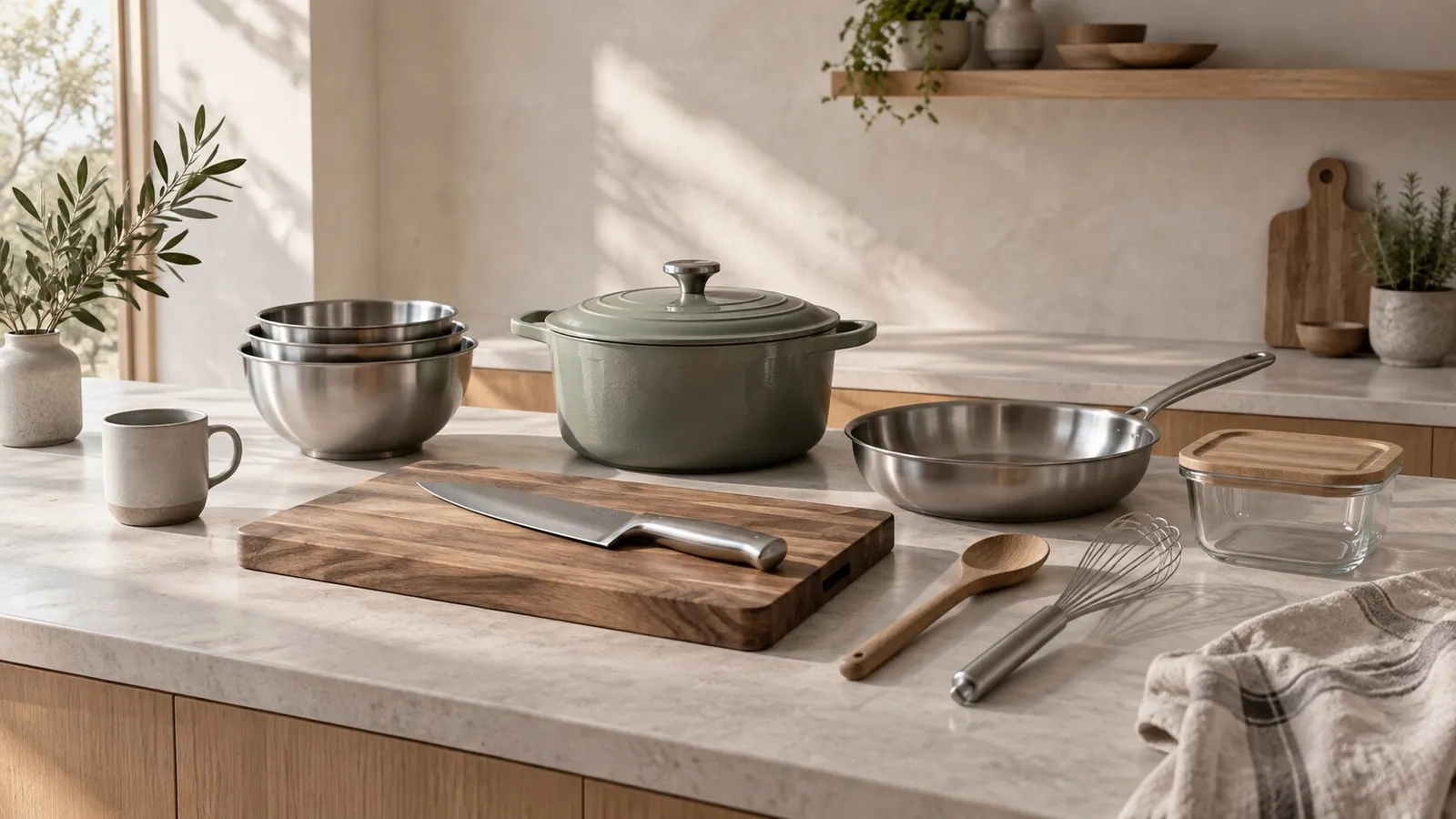
Editorial image for illustration; not a product-testing record or a documented kitchen project.
Some links may earn Zen Kitchen a commission if you buy, at no additional cost to you. Our evaluations are based on published sources. Read our affiliate policy.
A minimalist kitchen needs about thirty well-chosen items to cook almost anything: one good chef’s knife, a large cutting board, a cast-iron or carbon-steel skillet, a stainless skillet with a lid, a saucepan, a Dutch oven, a sheet pan or two, nesting bowls, a short toolkit of utensils, and a few storage containers. Everything on that list does more than one job. Everything off it has to argue its way in.
That’s the whole list in a sentence. The rest of this guide explains why each piece earns its place, what to look for when you buy it, what it lets you get rid of, and where to spend versus save.
One rule overrides everything below: essential is personal. If you eat rice every day, the rice cooker is essential. If you never bake, the rolling pin isn’t. Use this as a starting point you edit against your real cooking, not a standard to hit.
Every item here had to pass three questions.
Does it do more than one job? A Dutch oven braises, boils pasta, fries, and bakes bread. A garlic press presses garlic. Multi-use wins almost every time.
Would a daily cook reach for it at least weekly? If not, it belongs in the “nice to have” tier, or nowhere.
Can it last years, ideally decades? A minimalist kitchen is a buy-once kitchen. Fewer things, bought well, replaced rarely.
We also leaned on the same principles we use across the site: the 30-day use test for deciding what to keep, the 48-hour pause before buying anything new, and organizing by zone so every tool lives where its job happens. The list below is organized the same way.
A chef’s knife (8-inch, or 6-inch for smaller hands). This is the single most important tool in the kitchen, and most cooks do nearly all their cutting with it. Look for a full-tang blade that feels balanced in your hand, and a steel you can keep sharp at home. Knife constructions vary. Check the exact blade, handle, and care instructions rather than infer them from a country label. Price band: mid. A good one doesn’t need to be expensive, but a bad one makes every meal harder. Replaces: the 15-piece knife block.
A paring knife. For peeling, trimming, and in-hand work where a chef’s knife is clumsy. Inexpensive ones are fine; many cooks prefer them because they don’t mind replacing them. Price band: budget.
A serrated bread knife. Optional if you rarely buy crusty bread, genuinely useful if you do. It also handles tomatoes and delicate cakes. Price band: budget to mid.
A honing steel or whetstone. A sharp knife is safer and calmer to use than a dull one. A honing rod keeps the edge aligned between sharpenings; a whetstone or a professional sharpening once or twice a year restores it. Price band: budget.
One large cutting board, plus one small. Wood or rubber for the large one: both are kind to knife edges, and a good wooden board is the one kitchen object that looks better on the counter than in a cabinet. A smaller board handles raw meat or quick jobs. Skip glass and stone boards entirely; they dull knives fast. Price band: mid for the large board. Replaces: the stack of thin plastic boards.
A vegetable peeler. A Y-shaped peeler is faster and easier on the wrist than a swivel peeler for most people. You need one. Price band: budget.
A box grater or a rasp-style grater. A four-sided box grater covers cheese, vegetables, and zest. A fine rasp is better for citrus, garlic, ginger, and hard cheese. If you only buy one, choose based on what you grate most. Replaces: the dedicated zester, the garlic press, the ginger grater.
A cast-iron or carbon-steel skillet (10 to 12 inches). Sears, sautés, roasts, bakes cornbread, and goes from stovetop to oven. It develops a natural nonstick surface with use and will outlive you with minimal care. Cast iron holds heat longer; carbon steel is lighter and heats faster. Price band: budget to mid. Replaces: the grill pan, the second skillet, and in many kitchens the nonstick pan.
A stainless-steel skillet with a lid (10 to 12 inches). The pan for pan sauces, acidic dishes, and anything you’d hesitate to put in cast iron. Look for tri-ply or five-ply construction (layers of steel around an aluminum core) so it heats evenly without hot spots. Price band: mid to investment. Our full take on materials is in the non-toxic cookware guide.
A saucepan (2 to 3 quarts), with a lid. Grains, sauces, reheating, boiling eggs. Stainless or enameled. One is enough for most households. Price band: mid.
A Dutch oven (5 to 7 quarts). The most versatile pot you can own. Soups, braises, stews, beans, pasta, deep-frying, no-knead bread. Enameled cast iron is the classic choice because it’s heavy, even, and non-reactive. Price band: budget to investment, and the budget options are genuinely good here. We compare the main options in our best non-toxic cookware sets guide. Replaces: the stockpot for most households, the slow cooker for many.
One nonstick pan, optional. If eggs and fish are a daily thing, a single ceramic nonstick skillet makes life easier. Read the product’s care and replacement guidance, and see whether ceramic is really non-toxic before you buy.
Two rimmed sheet pans (half-sheet size). Roasted vegetables, sheet-pan dinners, cookies, toasting nuts, reheating leftovers. Heavy-gauge aluminum or stainless without a coating is the most durable choice. Two is the right number: one in the oven, one being loaded. Price band: budget. Replaces: the cookie sheets, the roasting pan for smaller roasts, the toaster-oven tray.
One baking dish (9x13 inch), ceramic or glass. Casseroles, lasagna, gratins, crumbles, roast chicken. Price band: budget.
A wire cooling rack that fits inside a sheet pan. Cools baked goods, but more usefully, turns a sheet pan into a roasting setup for crisp chicken or oven bacon. Price band: budget.
Everything else in baking (loaf pans, muffin tins, cake pans, pie dishes) belongs in the “if you bake” tier below.
Nesting mixing bowls (a set of three). Stainless is light and unbreakable; glass can go in the microwave and doubles as serving. A nested set takes the footprint of one bowl. Price band: budget.
Measuring cups and spoons. One set each. Price band: budget.
A glass liquid measuring cup (2 or 4 cups). Measures, microwaves, and pours. Price band: budget.
A digital kitchen scale. Arguably more useful than the cups, especially if you bake or follow recipes written in grams. It’s also more accurate and creates fewer dishes: you weigh straight into the bowl. Price band: budget.
An instant-read thermometer. The single fastest way to stop overcooking meat and fish. Price band: budget to mid.
This is where most kitchens have three of everything. You need one of each:
All of it fits in one drawer or one crock by the stove. If your utensil drawer doesn’t close, this is where to start editing.
An immersion blender. The one small appliance on the core list. It purées soup in the pot, makes smoothies in a jar, emulsifies dressings and mayonnaise, and handles most weeknight jobs you’d otherwise use a countertop blender or food processor for. It stores in a drawer. Price band: budget to mid. Replaces: the full blender for many households, and the mini food processor.
That’s it. Specialized cleaners for every surface are mostly packaging.
A set of glass food-storage containers with matching lids. Choose one brand and two or three sizes that nest. Mismatched lids are one of the most reliable sources of kitchen chaos, and a uniform set eliminates it. Heat suitability depends on the exact container and lid. Pyrex’s instructions distinguish intended uses; do not treat every glass container as oven-safe. Price band: mid. Replaces: the drawer of takeout containers.
A few jars for pantry staples. Only for things you buy often. We cover when decanting is worth it (and when it isn’t) in our guide to organizing a kitchen with no pantry.
Reusable wraps or a roll of parchment. Parchment lines sheet pans, wraps food, and replaces most uses of foil and plastic wrap.
A minimalist kitchen doesn’t need separate “everyday” and “entertaining” sets. Choose one set of dishes you love, in a quantity that fits your household plus a few guests, and use it every day. Simple, neutral stoneware or porcelain in one color mixes easily when you replace a broken piece.
A large bowl or platter for serving, a salad bowl, and a pitcher cover almost every occasion. The Dutch oven and baking dish go straight to the table.
Quantity is where kitchens quietly fill up. A useful rule: own enough for one full day of your household’s meals, plus enough for the number of people you actually host at once.
| Item | 1 person | 2 people | Family of 4 | Notes |
|---|---|---|---|---|
| Dinner plates | 4 | 6 | 8 | Add to match your usual guest count |
| Bowls | 4 | 6 | 8 | One shape that works for cereal, soup, and pasta |
| Small plates | 2–4 | 4 | 6–8 | Optional if dinner plates are modest in size |
| Mugs | 2–3 | 4 | 6 | The category most people have 20 of |
| Drinking glasses | 4 | 6 | 8 | One style, stackable if possible |
| Wine glasses | 2 | 4 | 4–6 | Or skip entirely and use tumblers |
| Cutlery sets | 4 | 6 | 8–10 | Forks run out first; a few extra spoons help |
| Kitchen towels | 4–6 | 6–8 | 8–10 | Enough for one laundry cycle |
| Food containers | 6–8 | 8–10 | 12–15 | Nesting, matching lids |
If you host large gatherings once or twice a year, borrow or rent for those days rather than storing twenty place settings for 363 days.
These aren’t clutter. They’re specialists. Keep them if your actual cooking calls for them, and let them go without guilt if it doesn’t.
| If you… | Consider | Why it earns a spot |
|---|---|---|
| Eat rice most days | A rice cooker | Hands-off, consistent, and often doubles as a steamer or porridge maker |
| Bake bread or cakes weekly | A stand mixer, loaf pan, and 9-inch cake pans | Real time savings for dough and batters; a hand mixer covers occasional bakers |
| Bake cookies and pies | A rolling pin, a pie dish, and a muffin tin | Hard to substitute well |
| Cook for a crowd or batch-cook | A larger 7+ quart Dutch oven or a stockpot | Stock, big batches of soup, and pasta for many |
| Make smoothies daily or blend nut milks | A full-size blender | An immersion blender struggles with ice and fibrous greens |
| Grind spices or coffee | A burr grinder or small spice grinder | A noticeable difference in flavor |
| Cook a lot of stir-fries | A carbon-steel wok | Faster and hotter than a skillet for that style of cooking |
| Make pressure-cooked beans and stocks | A multi-cooker | Can replace a slow cooker and rice cooker in one appliance |
| Prep lots of vegetables | A food processor | Slicing and shredding at volume; overkill for small households |
The pattern: a specialist tool earns its space when you use it at least weekly, or when it replaces two or more other things.
Most kitchens don’t have too few tools. They have too many single-purpose ones. These are the categories we’d let go of first.
Electric uni-taskers. Egg cookers, quesadilla makers, hot dog toasters, popcorn machines, electric can openers, bread makers used once, milk frothers used twice. Each does one narrow thing, often worse than a pan does it.
Single-job gadgets. Garlic press (a knife or rasp works), avocado slicer (a knife), strawberry huller (a paring knife), herb scissors (regular shears), banana slicer, pizza scissors, apple corer, egg separator (your hands or the shell).
Duplicates. The second vegetable peeler, the third cheese grater, the fourth wooden spoon, the nine mismatched spatulas. Keep the best one of each.
The knife block set. Most sets are three or four useful knives padded out with blades you never touch. Three good knives, bought individually, are usually better and often cheaper.
Matching “organizer” kits. Buying storage for things you don’t use is just clutter with a label on it.
Specialty bakeware for once-a-year recipes. Bundt pans, madeleine molds, novelty shapes. Borrow them.
If you’re not sure, box it up for 30 days. If you don’t open the box, you have your answer.
A minimalist kitchen is cheaper to run over time, but the upfront spend is where people get stuck. Here’s how we’d allocate a limited budget.
Spend on what you touch every day. The chef’s knife, the main skillet, and the Dutch oven are used most often, last longest, and make the biggest difference to how cooking feels. This is where a better tool pays for itself.
Save on the toolkit. Tongs, whisks, peelers, measuring spoons, and sheet pans are commodities. Restaurant-supply versions are cheap, durable, and often better than branded ones.
Buy cast iron and enameled cast iron at the budget end first. The difference between budget and premium is mostly finish, color, and weight. A budget Dutch oven cooks almost as well, and you can upgrade later if you want to.
Buy secondhand for the heavy stuff. Cast iron, stainless, and enameled pots are almost indestructible and show up at thrift stores and estate sales constantly. A little cleaning and reseasoning, and they’re as good as new.
Build slowly. Start with the knife, one skillet, one pot, one sheet pan, and the toolkit. Cook with them for a month. Then add only what you’ve actually missed. That gap between what you thought you needed and what you actually reached for is the most useful information you’ll get.
Print this page or copy the table for your household. This is an editorial checklist, not a required shopping list.
The core list, in one place. If you’d like to score your kitchen as you go, pair this with the Calm Kitchen Index, especially dimension 4, the essential-to-excess ratio.
| Zone | Item | Qty | Have it? |
|---|---|---|---|
| Prep | Chef’s knife | 1 | ☐ |
| Prep | Paring knife | 1 | ☐ |
| Prep | Serrated bread knife | 1 | ☐ |
| Prep | Honing steel or whetstone | 1 | ☐ |
| Prep | Large cutting board + small board | 2 | ☐ |
| Prep | Peeler | 1 | ☐ |
| Prep | Box grater or rasp | 1 | ☐ |
| Cooking | Cast-iron or carbon-steel skillet | 1 | ☐ |
| Cooking | Stainless skillet with lid | 1 | ☐ |
| Cooking | Saucepan with lid | 1 | ☐ |
| Cooking | Dutch oven, 5–7 qt | 1 | ☐ |
| Cooking | Ceramic nonstick skillet (optional) | 0–1 | ☐ |
| Baking | Rimmed half-sheet pans | 2 | ☐ |
| Baking | 9x13 baking dish | 1 | ☐ |
| Baking | Wire rack | 1 | ☐ |
| Measuring | Nesting mixing bowls | 3 | ☐ |
| Measuring | Measuring cups and spoons | 1 set each | ☐ |
| Measuring | Glass liquid measure | 1 | ☐ |
| Measuring | Digital scale | 1 | ☐ |
| Measuring | Instant-read thermometer | 1 | ☐ |
| Toolkit | Tongs, silicone spatula, fish spatula, wooden spoon, whisk, ladle | 1 each | ☐ |
| Toolkit | Colander and fine-mesh sieve | 1 each | ☐ |
| Toolkit | Can opener and kitchen shears | 1 each | ☐ |
| Toolkit | Immersion blender | 1 | ☐ |
| Cleaning | Dish brush, drying rack or mat, bench scraper | 1 each | ☐ |
| Cleaning | Kitchen towels | 6–8 | ☐ |
| Storage | Matching glass containers | 8–10 | ☐ |
| Serving | Plates, bowls, glasses, cutlery | See quantity table | ☐ |
What are the essentials for a minimalist kitchen? One chef’s knife, a cutting board, a cast-iron or carbon-steel skillet, a stainless skillet with a lid, a saucepan, a Dutch oven, two sheet pans, nesting bowls, measuring tools, a small utensil kit, an immersion blender, and matching storage containers. That covers nearly every everyday recipe.
How many pots and pans does a minimalist kitchen need? Four for most households: a cast-iron or carbon-steel skillet, a stainless skillet, a saucepan, and a Dutch oven. Add a nonstick pan if you cook eggs daily, and a stockpot only if you regularly cook for a crowd.
Do I need a knife set? No. Most people use one chef’s knife for almost everything. Add a paring knife and a serrated knife and you have what most sets offer, without the blades you’ll never use.
What small appliances are worth keeping? An immersion blender for almost everyone, plus whichever appliance matches your daily habits: a kettle or coffee maker, a rice cooker if you eat rice often, a stand mixer if you bake weekly. Everything else should earn its space by weekly use.
How do I build a minimalist kitchen on a budget? Start by editing what you already own, which costs nothing. Then buy the knife and main skillet first, get the toolkit from a restaurant-supply store, and look for cast iron and stainless secondhand. Add pieces only after you’ve noticed you need them.
Is a minimalist kitchen practical for families? Yes. The list stays the same; the quantities grow. A family of four may want a larger Dutch oven, more containers, and more place settings, but the principle of one good tool per job still applies.
What’s the first thing to get rid of? Duplicates. They’re the easiest decision because you’re keeping the best version of the same thing, so nothing is lost. After that, electric single-taskers you haven’t used in a year.
Don’t start by shopping. Start by pulling every utensil out of its drawer and putting back only one of each. Then do the same with your pots and pans. You’ll likely find you already own most of this list, just buried under things that aren’t on it.
When you do buy, buy the thing you missed most during that first month, and buy it well.
For the bigger picture of how the room itself should work, read The Complete Guide to a Minimalist Kitchen. For where all of this should live once you’ve edited it down, see our small kitchen organization ideas.
Keep reading: The Complete Guide to a Minimalist Kitchen · How to Declutter Your Kitchen Counters · Small Kitchen Organization Ideas · Best Non-Toxic Cookware Sets in 2026
Sources describe their own scope and limitations. Read our sourcing policy.
Read more from the Minimalist Kitchen Living pillar.
Minimalist
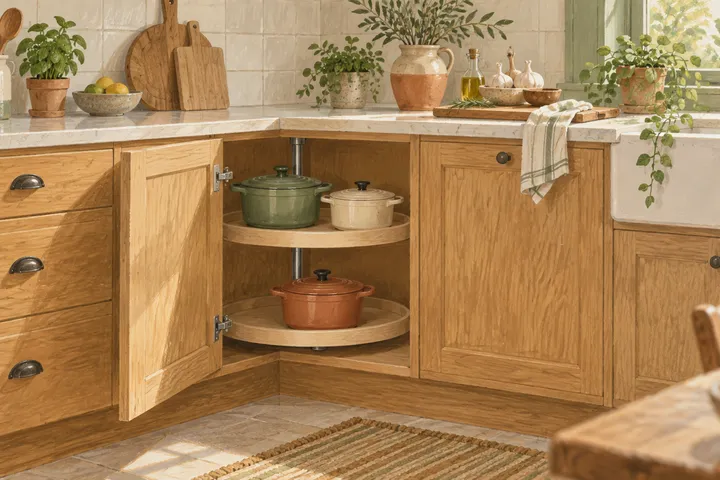
Identify corner cabinet types, map easy-reach zones and compare simple layouts with correctly matched rotating or swing-out fittings.
6 min read
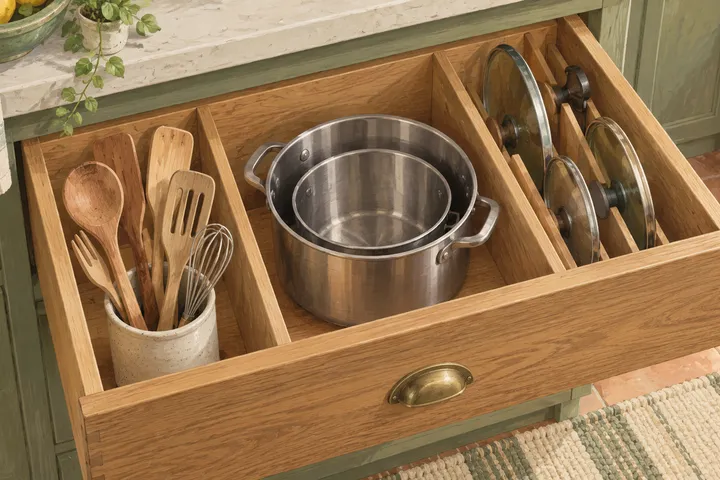
Measure usable drawer space, choose practical layouts for utensils, cookware and dry goods, and test the arrangement before buying organizers.
7 min read
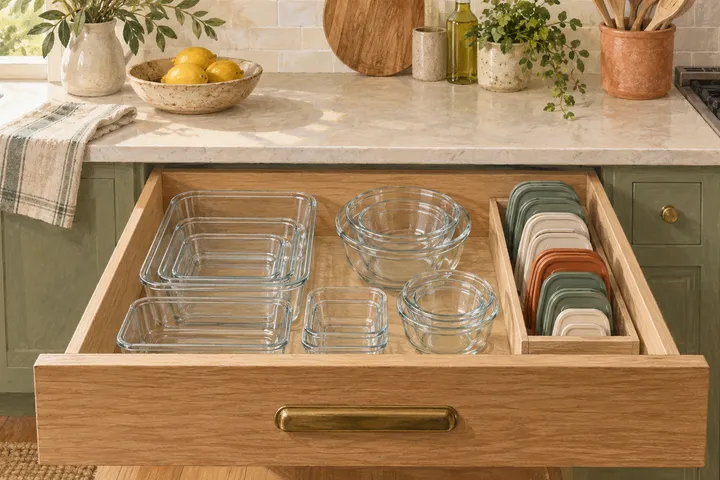
Match containers to lids and real meals, then choose nesting, upright dividers or assembled pairs with a practical weekly worksheet.
7 min read