
Caraway Cookware Review: 6 Months of Honest Testing
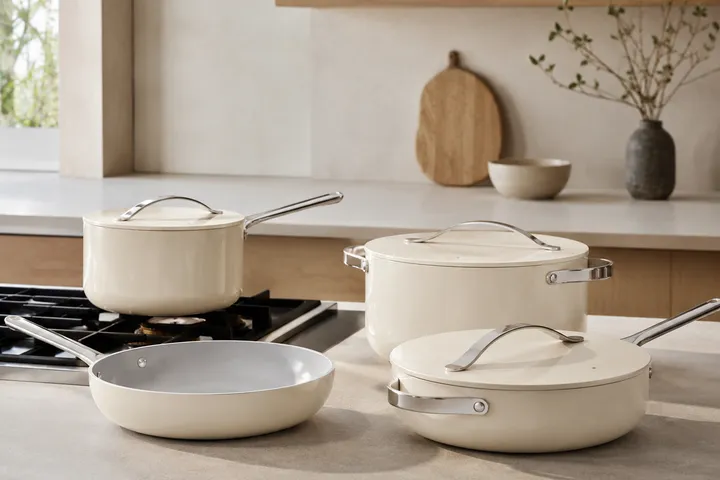
We cooked on Caraway's ceramic set every day for six months. Here's the honest verdict on the non-toxic claims, induction, coating longevity, and whether $395 is worth it.
We scored eight non-toxic cookware sets on safety, durability, beauty, value, and price. The honest verdict: stainless and cast iron win on safety and lifespan, ceramic wins on looks and ease, and a few "non-toxic" labels do not hold up.

Last updated: June 2026. This guide contains affiliate links. If you buy through one, we may earn a small commission at no cost to you. We only point to gear we’d actually keep in our own kitchen.
The best non-toxic cookware set for most people is an uncoated tri-ply stainless steel set, either the All-Clad D3 or the USA-made 360 Cookware set, because there is no coating to wear out, flake, or leach. If you want true nonstick ease, a transparently lab-tested ceramic set from Caraway or GreenPan is the better fit, as long as you accept one thing up front: every ceramic coating is a consumable that fades in roughly one to three years, not a lifetime surface.
That single trade-off, lifespan versus easy release, is the whole decision. We’ll show you which sets land where, what their safety claims actually mean, and which “non-toxic” labels we’d walk past.
“Non-toxic” is a marketing word, not a regulated one, so the useful question is which chemicals a pan avoids. The four that matter in a kitchen are PFAS, PFOA, PTFE, and the heavy metals lead and cadmium.
Here is the part most product pages blur. PFAS is the whole family of “forever chemicals,” more than 12,000 compounds by the National Academies’ count. PFOA and PTFE (the technical name for Teflon) are both members of that family. So “PFOA-free” only tells you one banned chemical is gone. “PTFE-free” tells you there’s no fluoropolymer coating. Only “PFAS-free” covers the entire group. When a pan says “PFOA-free” but stays quiet about PTFE or PFAS, read that silence as an answer.
Why people care: per the CDC’s national biomonitoring (NHANES), detectable PFAS show up in the blood of more than 98% of Americans tested. PTFE coatings are stable at low heat but start breaking down around 500°F and can release fumes above that. Lead and cadmium are a separate worry, and they live mostly in bright enamel glazes, the reds, oranges, and yellows.
Demand is real, not invented. In a nationally representative Consumer Reports survey of 2,158 U.S. adults in April 2025, 65% said they were at least somewhat concerned about PFOA, PTFE, or PFAS in their nonstick cookware. The market researcher HTF pegs the non-toxic cookware category at roughly $7.2 billion in 2025, growing toward $12.8 billion by 2033 (treat that as a directional industry estimate, not audited data).
Regulation is catching up fast. Starting January 1, 2026, a cluster of states including Maine, Minnesota, Colorado, Connecticut, Vermont, Washington, and Illinois began restricting intentionally added PFAS in consumer products, cookware among them, with Maine and Minnesota writing the broadest cookware-inclusive bans. By 2032, Maine, Minnesota, and New Mexico will bar nearly all intentionally added PFAS unless a product earns an exemption. Industry pushes back: the Cookware Sustainability Alliance argues the fluoropolymers used on cookware are inert and will not bind with human cells. That debate is unresolved. What it means for you is simpler: the whole industry is moving toward ceramic and stainless, so your options keep getting better.
Every set runs through our Conscious Cookware Scorecard, five dimensions rated 1 to 5. Safety is the claim plus the evidence behind it. Durability is lifespan and how it holds up to real use. Beauty is whether you’d leave it on the stove. Value is what you get for the money over the years you’ll own it. Price rates affordability, where a 5 is gentle on the wallet and a 1 is a real investment.
The table is the part worth saving.
| Set | Material | Approx. 2026 price | Safety | Durability | Beauty | Value | Price |
|---|---|---|---|---|---|---|---|
| All-Clad D3 (10-pc) | Tri-ply stainless | ~$1,080 list, often discounted | 5 | 5 | 4 | 4 | 2 |
| 360 Cookware | Surgical stainless, USA | Premium, lifetime warranty | 5 | 5 | 3 | 4 | 2 |
| Caraway (7-pc) | Ceramic on aluminum | ~$395 (frequent sales) | 4 | 2.5 | 5 | 3 | 3 |
| GreenPan Valencia Pro (11-pc) | Thermolon ceramic, hard-anodized | ~$550 | 4.5 | 3 | 3.5 | 3.5 | 2.5 |
| Our Place (13-pc) | Thermakind ceramic on aluminum | ~$298 and up | 4 | 2.5 | 5 | 3.5 | 3.5 |
| Lodge enameled cast iron | Enameled cast iron | ~$80 per Dutch oven | 4.5 | 5 | 3.5 | 5 | 5 |
| Le Creuset / Staub | Enameled cast iron | ~$325–400 per Dutch oven | 4.5 | 5 | 5 | 3 | 2 |
| Made In | 5-ply stainless | Mid-to-high | 5 | 5 | 4 | 4 | 2.5 |
A note on the numbers: prices swing hard with sales, especially around Mother’s Day and the November holidays, so read every figure as an approximate 2026 list price. And “lifetime” honestly applies only to stainless and cast iron. No ceramic coating earns that word.
All-Clad D3 is the set we’d hand someone who wants to buy once and stop thinking about it. It’s tri-ply 18/10 stainless with an aluminum core, bonded and assembled in Canonsburg, Pennsylvania since 1971. Oven and broiler safe to 600°F, induction compatible, limited lifetime warranty.
On safety it’s a 5 for the boring reason that matters most: no coating means nothing to degrade. Independent aggregators that test cookware put All-Clad stainless in their top tier, and the brand third-party tests for safety. In Homes & Gardens’ extended testing, the D3 line came out the top non-toxic pick for even heating and reliable searing across every cooktop.
The honest drawback is technique. Stainless rewards a proper preheat and enough fat, and it punishes impatience. Eggs will stick if you rush. If you’ve only ever cooked on nonstick, there’s a two-week learning curve before the pan starts feeling effortless. The 10-piece set lists around $1,080 and is almost always discounted somewhere, so don’t pay sticker.
If All-Clad is the classic, 360 Cookware is the quiet overachiever. It’s surgical-grade T-304 stainless on the cooking surface with a magnetic exterior and aluminum core, made in West Bend, Wisconsin in a Green-E-certified plant that uses a dry-sanding finishing process instead of harsh chemicals. Oven safe to 500°F, induction compatible, and backed by an unconditional lifetime warranty.
Safety is a clean 5, with the only realistic caveat being nickel content for the small number of people with a nickel allergy. Durability is where it shines. One Taste of Home tester who’d been cooking on it since mid-2025 called it the last cookware she’ll ever need, and the lifetime warranty makes that a reasonable bet. It runs premium (a 4-quart set retails around $450), but spread across a few decades of use, the cost per year is tiny. One care note: harsh dishwasher detergents with hydroxides can void the warranty, so check the label.
It loses a point on beauty only because it’s handsome in a workshop way rather than a magazine way. Nobody buys 360 for the photos.
Caraway is the set people fall for, and we understand why. Aluminum body, stainless handles, a proprietary mineral ceramic coating, eight-plus colorways, and a magnetic storage rack that genuinely keeps a cabinet sane. Oven safe to 550°F, works on induction. The 7-piece set lists around $445 and dips near $395 on sale.
On safety, Caraway is the most transparent brand in ceramic. It publishes its third-party lab reports, testing for over 200 PFAS and 20-plus heavy metals through partners like Light Labs, with PFAS, PTFE, lead, and cadmium all reported as “not detected.” That word matters: “not detected” means below the lab’s reporting limit under set conditions, not a guarantee of zero. There’s also a documented wrinkle. One independent researcher’s at-home XRF test flagged trace titanium and other metals in the coating itself, though Caraway’s leach testing shows nothing migrating into food, and regulators don’t treat titanium dioxide as a leaching hazard here. Worth knowing, not worth panicking over. And in August 2025, the BBB’s National Advertising Division reviewed Caraway’s marketing and found its “PFAS-free” and “non-toxic” claims supported, while telling the brand to drop comparative claims implying competitors’ pans are toxic. We read that as a net point in Caraway’s favor: the core safety claim survived independent scrutiny.
The real knock is durability, and we won’t soft-pedal it. Caraway scores a 2.5 because the coating is a consumable. Long-term testers and owners report the nonstick fading anywhere from several months to a couple of years (one detailed test had eggs starting to grab around the five-month mark, with exterior chipping inside the first month), and the warranty is only one year, which is short for the price. LeafScore, after two years of hands-on use, dropped Caraway from its top five-leaf rating to four over durability. Buy it for the looks and the easy release, treat it gently, and budget to replace it.
If you want ceramic that lasts a little longer, GreenPan Valencia Pro is the one. It’s GreenPan’s Thermolon ceramic, diamond-reinforced, over a hard-anodized aluminum body with a magnetic induction base and stainless handles. Oven and broiler safe to 600°F, dishwasher safe, limited lifetime warranty on the cookware itself. The 11-piece set runs around $550.
Safety earns a 4.5. Thermolon is a silica-based sol-gel coating, and the independent Ecology Center confirmed it contains no PTFE and no detectable PFOA. GreenPan pioneered PFAS-free ceramic back in 2007, and the newest Thermolon generation is billed as the first NSF-certified ceramic nonstick. The hard-anodized body and diamond reinforcement push durability to a 3, better than most ceramic, and the set has won America’s Test Kitchen’s nod for best ceramic frypan. It’s still a coating, so the same replace-eventually rule applies, just on a slightly longer clock.
The trade-off is looks. The gray hard-anodized finish reads more pro-kitchen than warm-minimalist. Capable, not cozy.
Our Place built its name on the Always Pan, and the logic still holds: one well-designed pan that browns, boils, steams, and serves does the work of a small pile of single-taskers. The 13-piece set claims to replace 36-plus pieces, which is the whole pitch for a tight kitchen. Recycled aluminum body, Thermakind ceramic, oven safe to 450°F including the lids, induction compatible, three-year warranty.
Safety lands at a 4. Thermakind is made without PFAS, PTFE, PFOA, lead, and cadmium, derived mostly from sand, water, and alcohol, and Our Place is upfront about the formulation. Consumer Reports testing reportedly found zero of 96 PFAS in an Our Place pan. The one ding on transparency: unlike Caraway, Our Place doesn’t publish its full third-party reports publicly, which reviewers who track this stuff flag as a gap.
Durability is the familiar ceramic story, a 2.5, with Thermakind marketed as longer-lasting than the brand’s old coating but still a one-to-three-year surface. Design is where Our Place is untouchable, with pour spouts, nesting pieces, and colorways made for a small, pretty kitchen. If you’d rather skip the coating question entirely, the brand also sells a coating-free Titanium Always Pan Pro that’s oven safe far higher and carries a limited lifetime warranty.
Lodge is the answer to “I want non-toxic and I don’t want to spend a fortune.” Enameled cast iron is made without PFOA or PTFE, doesn’t react with acidic food, and has no nonstick layer to shed. A Lodge enameled Dutch oven runs around $80, against $325 to $400 for the French names.
Safety is a 4.5. Lodge certifies compliance with FDA test methods and California Prop 65. The one caveat for cast iron broadly: bright enamel colors can carry cadmium for pigment, and some at-home testers have flagged lead on certain pieces, so if that’s a concern, lean toward darker interiors and neutral exteriors. Durability is a flat 5. This is a generational pan. In CNN Underscored’s testing, the Lodge Dutch oven went toe to toe with Le Creuset, with Le Creuset edging ahead only on boil speed and handle room. For the price difference, most cooks won’t miss the gap.
What you give up is refinement. Lodge enamel is a touch heavier and less silky than the premium tier, and the color range is plainer. Function over flourish.
If cast iron is going to live on your stove and in your photos, Le Creuset and Staub are worth the money. Both are enameled cast iron with the same coating-free safety story (a 4.5, with the same colored-glaze cadmium caveat, bound in an anti-acid frit so it shouldn’t leach). Both are effectively lifetime tools with generous warranties.
The difference between them is character. Le Creuset gives you the widest color range and the lightest-colored interiors for watching a fond develop. Staub’s black matte interior hides stains and tends to test cleaner for lead and cadmium in informal user checks. Either one is a 5 on beauty and a piece you’ll hand down. You’re paying for finish, color, and resale value, and in this category that’s a fair trade.
Worth a mention alongside All-Clad: Made In 5-ply Stainless Clad, made in the USA and Italy, oven safe to a very high 800°F, with a lifetime warranty and a slightly friendlier price than All-Clad’s flagship. Same coating-free 5 on safety, same heirloom durability. If the All-Clad set is sold out or over budget, this is the one to reach for instead.
Not every popular pan that markets itself as clean clears the bar.
HexClad. The hybrid stainless-and-ceramic look is appealing, but the original surface still uses PTFE in the recessed hexagons. HexClad agreed to a $2.5 million settlement over marketing PTFE-containing pans as “non-toxic” and “PFAS-free,” with the final-approval hearing held February 20, 2026. As part of the deal, HexClad agreed to stop calling products “non-toxic,” “PFAS-free,” or “PFOA-free” if they contain PTFE. There’s a newer ceramic line, but it’s too recent to vouch for. If true PFAS-free is your goal, this isn’t the set.
Material’s Coated Pan. It’s a well-made 5-ply copper-core pan with a lifetime guarantee, and The Kitchn likes it. But Material only claims “Teflon-free, PFOA-free, lead-free, cadmium-free.” It does not claim PTFE-free or PFAS-free, and we couldn’t find a third-party PFAS chemical test to fill that gap. In a guide built on the PFAS-free standard, that omission keeps it off the main list.
Xtrema. The 100% ceramic pans pass Mamavation’s acid-leach test, but Tamara Rubin’s 2018 XRF testing detected lead, cadmium, and cobalt in the ceramic body itself. Those findings genuinely conflict, and we’d rather you see the disagreement than have us pretend it’s settled.
After going through the published lab reports and the long-term owner tests, one pattern is hard to ignore. The sets that win on safety are the ones with nothing to degrade. Stainless and cast iron don’t have a coating clock ticking, which is why they keep landing at the top of every serious testing roundup and why they’re the only pieces here that honestly earn the word “lifetime.”
Ceramic is the genuine pleasure of this category, and also its weak spot. The easy release is real. So is the fade. Across the testing we trust, the practical lifespan of a ceramic pan is one to three years of regular use, sometimes less if you crank the heat or run it through the dishwasher. That’s not a scandal. It’s just the deal, and the brands that own it (Caraway publishing its reports, GreenPan getting NSF certified) are the ones we’d actually buy.
Our honest read: most kitchens are best served by a stainless set plus one cast-iron Dutch oven, with a single ceramic pan kept around for eggs and fish. That covers everything, stays safe for decades, and costs less over ten years than replacing a full ceramic set every two.
What is the safest non-toxic cookware? Uncoated stainless steel and bare or enameled cast iron are the safest, because there’s no nonstick coating to wear down or leach. They consistently rank in the top tier of independent cookware safety testing.
Is ceramic cookware really non-toxic? The good ones are. Quality ceramic coatings like Caraway’s and GreenPan’s Thermolon are made without PFAS, PTFE, lead, and cadmium, and the better brands publish third-party tests to prove it. The catch is lifespan: ceramic stays non-toxic but loses its nonstick over one to three years.
Is Caraway worth it? For the looks, the easy release, and the published safety testing, yes, if you accept a one-to-three-year coating life and a short one-year warranty. If you want something that lasts decades, stainless or cast iron is the smarter spend.
Does non-toxic cookware work on induction? Yes. Every set in this guide is induction compatible. Stainless and cast iron couple especially well because their magnetic bases transfer heat efficiently.
What’s the difference between PFOA-free and PFAS-free? PFOA is one chemical. PFAS is the whole family of thousands, including PFOA and PTFE. “PFAS-free” is the stronger, more complete claim. If a pan says only “PFOA-free,” it can still contain other PFAS.
What cookware is both safe and good-looking? For a warm, design-forward kitchen, Caraway and Our Place lead on ceramic, and Le Creuset leads on cast iron. If you want something that’s beautiful and lasts forever, Le Creuset enameled cast iron is the pick.
How long does ceramic nonstick last? Plan on one to three years of regular use before the nonstick noticeably fades. Low-to-medium heat, no metal utensils, no cooking sprays, and hand-washing all stretch it.
If you take one thing from this guide: buy a tri-ply stainless set (All-Clad D3 or 360 Cookware) and add one Lodge or Le Creuset Dutch oven. It’s the safest path, and over a decade it’s also the cheapest, because you’re not replacing anything.
Want the nonstick experience too? Add a single ceramic pan from Caraway (best looks and the most transparent testing) or GreenPan Valencia Pro (longest-lasting ceramic). Treat it as a consumable, cook low and slow, and replace it when the eggs start to grab. Prices on all of these move with the season, so it’s worth waiting for a sale rather than paying list.
Keep reading: The Non-Toxic Kitchen: PFAS-Free Cookware & Safe Materials · Caraway Cookware Review: 6 Months of Honest Testing · GreenPan vs Caraway: Which Non-Toxic Cookware Wins? · Is Ceramic Cookware Really Non-Toxic? What the Science Says · Best PFAS-Free Pots and Pans for Induction Stoves
Read more from the Non-Toxic Product Curation pillar.
Non-Toxic
We cooked on Caraway's ceramic set every day for six months. Here's the honest verdict on the non-toxic claims, induction, coating longevity, and whether $395 is worth it.
A direct comparison of GreenPan and Caraway ceramic-coated cookware — coating technology, heat performance, durability over time, price, and which one makes sense for different kitchens.
A clear-headed look at what 'ceramic' cookware actually means, what coatings are used, which certifications matter, and how to tell whether a ceramic pan is genuinely non-toxic or just marketed that way.